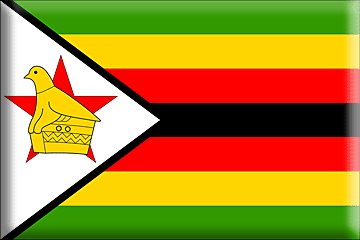
O lift high the banner, the flag of Zimbabwe. The symbol of freedom proclaiming victory; We praise our heros' sacrifice, And vow to keep our land from foes; And may the Almighty protect and bless our land. O lovely Zimbabwe, so wondrously adorned; With mountains, and rivers cascading, flowing free; And may the Almighty protect and bless our land. O God, we beseech Thee to bless our native land; The land of our fathers bestowed upon us all.
Wednesday 25 April 2012
Zimbabwe and the greedy West: It's the minerals and land, stupid!
by: Nathaniel Manheru I Herald
I HAVE just been reading C G Tracey’s “All for Nothing?”, itself a weeping autobiography by one of Rhodesia’s leading farmers and, especially after UDI, one of Rhodesia’s leading sanctions-busters.
The book is tearful about the loss of Tracey’s Mount Shannon, aka Mount Lothian farm, apparently in the course of our land reforms. But the book gives one the sense that this land loss triggers a long introspection in Tracey, much of it coinciding with major turns and shifts in the life of Southern Rhodesia both before and after UDI.
But that is a story for another day. My interest is one forthright sentence Tracey uses to introduce a chapter of the book. The forthright sentence reads: “Gold mining was the reason that Rhodesia was opened up in the first place, and agricultural development took place around that thrust.”
Land to Niggers
I was struck by the sheer clarity, the remarkably unadorned forthrightness of this simple statement which profoundly summarises my fate and that of my people and country, Zimbabwe. And of course one can choose to treat gold as a singular, specific mineral, or as a metaphor depicting the overriding mining interests that were at the heart of Zimbabwe’s invasion and occupation, at the heart of its long colonialism. And as Tracey’s matter-of-fact statement attests, the mining interests were bolstered by land interests.
My mind then wonders back to the days of Cecil John Rhodes, the man credited with founding us, we who already inhabited the hills and valleys which his rag-tag army only reached for the first time in 1890.
A white historian, one Patrick Keatley, quotes Rhodes as saying in a moment of candour: “I prefer land to niggers,” again another pithy, straightforwardly cold statement of fact and unambiguous white interest. The accent is on resources, land-based resources of my country, of my people.
Highly Mineralised Country
I wonder on, in the process stumbling upon the Rudd Concession whose wording in part reads: “I, Lobengula, King of Matabeleland and Mashonaland and other adjoining territories, with the consent of my Council of Indunas, do hereby grant and assign... complete and exclusive charge over all metals and minerals situated and contained in my kingdoms."
I cast aside the duplicity involved in that whole document, a document so well couched in the language of English Law, yet purporting to carry the mind of an African Ndebele King, my king, my forbear. That, too, is a matter for another day.
My real focus is on “all metals and minerals” which amount to the centre of this fudged, fraudulent agreement involving a monarch still to build a defending literacy such as we now have, or should have. To all these statements add Ian Smith’s pregnant but often overlooked statement of fact: “Rhodesia is one of the most mineralised countries on the African continent.”
A clear, emphatic thread runs through: across time, across persons, across preoccupations, indeed across temperaments. And in all these utterances, you are struck by the simplicity of white mission, sheer clarity of mission and purpose.
Contrast this matter-of-factness, this clarity with our own muddled thinking as Africans, muddled thinking in characterising the colonial rain that beat us, and by implication the sunshine that must dry us up in post-independence.
We talk colonialism as if Rhodes and his variegated bunch of thugs and urchins invaded this country solely to misgovern us. They did not. To think and believe so would then imply the dialectic between us and colonialism is over governance issues, over structures of political power.
Such a reading gives us a completely different national purpose. But it also misreads history, misreads it disastrously. History records that the so-called pioneers were disbanded soon after the September hoisting of the Union Jack at Cecil Square, now Africa Unity Square. Disbanded to prospect for mines and minerals. Disbanded to identify and take possession of the best land.
Mines, minerals flowed from the myth of the Orphir — the legendary site of King Solomon. And the old workings done by our forbears gave these itinerant ruffians much clue, which is why most of the big mines of Southern Rhodesia developed from sites worked by Africans in their great trade with potentates of Asia, Middle East, Persia and, much later, the Portuguese.
Producers of incredible rice
History records that Mashona contacts with the rest of the developed world centred around trade in minerals and metals. We traded in minerals with older civilisations of Persia, Asia and the Middle East, trade that could have predated AD1200.
The English do not exist at all when we enter this trade; they don’t even exist as a people, let alone as a nation. They only become a factor close to the occupation of Zimbabwe, even then following far behind the Portuguese and the Germans, the latter represented by Karl Mauch.
In his record of travels, Mauch makes the following entry: “The high-veld of the watershed consists of a grassy plain with trees that can be easily counted. Towards the north-east, the Mashona tribe, which is partly subject to Mosilikatse, produces an incredible amount of rice which served us as an unexpected addition to our everlasting dry meat-fare.” Clearly the land was in use, very productive use for surplus.
Native miner, native beneficiation
In July 1867, the German geologist made an even more dramatic entry which I shall quote in extenso: “... Hartley brought me the news that, when following a wounded elephant, he passed several pits dug into quartz, and that he suspected that the former inhabitants of the country had dug for metal there, but what kind of metal he had not been able to discover.
“Following Hartley’s description, I should be able to reach this site from our camp in one day. And so I started the following day, armed with a hammer, to search in the indicated direction. I passed a small river at a distance of about 4,5 English miles, the rubble and sand of which stemmed from ‘talk’ gneiss stone.
“On the other riverbank, I came to a bare patch of brackish soil on which, at a distance of 1,5 miles, a distinct white line across the burnt black ground could be made out. On my approach this proved to be a quartz vein which protruded in places to a height of up to 4 feet. I soon came to this line, and a few paces alongside it, I came to a site which I recognised as a smelting place. This was about 10 feet in diameter and contained slag, quartzstone, pieces of clay pipes, ash and coal. There were some pits 4 to 5 feet deep at a distance of about 50 paces, placed in openings of the quartz vein. Yet further on there was one pit 10 feet deep, but, this was filled with two feet of water, which probably prevented any further digging by the natives.
“On examining some of the recovered stones, I found ‘Bleiganz’ which was extraordinarily shiny, and had a small silver content, and GOLD. I looked at the extension of the vein and made speculations which, later on, proved to be correct. Highly pleased, I put my hammer into my belt, shouldered my rifle and ran, rather walked, back to camp to impart this good news.”
So was found the Tati goldfields, themselves the focus of Rhodes’ pioneers soon after hoisting the Union Jack. The natives in question are ourselves, already engaged in mining and minerals processing well before Rhodesia.
What followed this Western discovery was what historians have termed the “shovel and sieve” age, with gold-seekers working extensively on both alluvial deposits, and on deposits more deeply embedded in the hard African stone which make the backbone to our country. Dear Zimbo, mining did not happen after us. It began with us, making us masters of rock, masters of metal. Always bear this in mind when you interact with the world.
Challenging heresies of colonial history
And of course the occupation of Zimbabwe followed well behind a wave of gold-seekers and treasure hunters who invaded and ransacked the country well before Rhodes dreamt of colouring us pink, British pink.
I restate, we were invaded and occupied for our minerals, with colonial misgovernance attaching to the whole mining enterprise as a concomitant, an incidental, necessary, bothersome evil needed to stabilise matters for quieter, more profitable mining and much, much later, more profitable, monopoly farming. Serious farming only takes place after the First World War, with colonial reports clearly indicating the settler community lived off the produce of industrious African farmers.
We are people of the land, sons and daughters of the soil. Let no one deceive us; let no one propagate the heresy that we learnt about the soil from the white man, the heresy that this land was empty, unused until the white man came. Simply, it wasn’t.
Small but significant quarrel
Today, we talk and think as if the firstlings of settler colonialism in Zimbabwe was governance. That is very flawed thinking, so monumentally flawed as to spawn a train of other lethal mischaracterisations, including and principally an existential one. Do we know why we exist, given our historical circumstances?
We have just celebrated 32 years of Independence, a quarrelsome lot. And what was the quarrel over? It was over the theme for the commemorations. The committee responsible for State occasions recommended “Indigenisation and Economic Empowerment for Social and Economic Transformation” as the theme for this year. The recommendation went up to Cabinet for adoption. It was adopted virtually uneventfully, with a small but telling suggestion coming from MDC-T.
The small but significant suggestion was to trim the theme to “Social and Economic Transformation”. What is now being recorded as MDC-T objection to the theme was a belated protest, an obligatory afterthought that only came well after a decision had been made by Government. Still, that does not lessen its importance and what it portents for the politics of this country.
Old culture of expropriation
The MDC-T objections are quite telling: “We are not opposed to the day, but we are strongly opposed to the message of indigenisation and to use a national day to launch a Zanu PF theme; that is what we are opposed to.”
Morgan Tsvangirai went further: “We have disagreed in this government because there are others who want to perpetuate the old culture of expropriation, looting and self-aggrandisement clad in new and misleading nomenclature such as indigenisation.”
The scope and line of attack is clear; it encompasses land reform as “the old culture of expropriation”, attacks the indigenisation of the mining sector as a new name for an old vice. It is an attack which, as should be clear from the foregoing, is rooted in the history and politics of this country, specifically rooted in composite white colonial interests as they relate to the land which they viewed as better valued than niggers, indeed as they relate to metals and minerals which they gave better regard clean, honest international relations with the Ndebele state.
The only difference is that while in the foregoing I was, of necessity, restricted to culling quotes from white players, this time around I find there is a black mouth, black tongue articulating the selfsame white interests.
Our independence, your sacrifice
And there is an implied mission in Tsvangirai’s frustration with the theme: that MDC-T was put into the inclusive equation to empty the national day of any radical, national message, to give the national day a new, innocuous meaning. Otherwise how does one embrace the day and oppose the message? After all is the day itself not the message?
But one is also hit by the man’s lack of irony. He proceeds: “It is regrettable that Independence Day has been monopolised and personalised by one political party. This is a national day that is greater than Zanu PF, the MDC, Mavambo or any other political formation. Independence Day is a day greater than Morgan Tsvangirai, Robert Mugabe, Welshman Ncube, Arthur Mutambara or Simba Makoni . . . To adorn Independence Day in a Zanu PF robe is to rob it of its national character and its universal appeal to the diverse people of Zimbabwe who are all too aware of its mammoth significance to the story of this land.”
Maybe we have been too polite for too long. The struggle, with all its horrendous toll, was monopolised by one party, united Zanu PF. No one worried then, including Tsvangirai who was not only old enough to go to war, but as near to the border with Mozambique as Mutare. He bravely chose to stay inside the country, leaving the reckless Zanu PF to monopolise the fight. He worried more about the education of his siblings, he tells one of his white biographers.
Today political colonialism has fallen and hey, our man bravely thrusts himself into the frontline, ready to be mowed down by deadly bullets of post-liberation peace, post-liberation premiership! Well, let him get it today: only the united Zanu PF is the source of Zimbabwe’s Independence. It fought for that Independence; it sacrificed for it, mobilised for it and, what is more, continues to defend it to this day. Let that be pressed home.
Neither time nor memory will ever redistribute this historic achievement by Zanu PF, all to benefit little, latter-day parties, least of all those speaking for, and defending white interests. Never! Those that stayed home, those that betrayed the struggle even, please demand with humility. This our-glory-together-in-independence, your-sacrifice-alone-struggle, shall not wash. To each according to their contribution, that is the mantra.
Biti lipsticks the status quo
But I am running too far ahead. The MDC-T has said more. Tendai Biti, its secretary general, thinks Indigenisation law is “absurd”. “It wasn’t well thought. Due process not being followed, we need to go back to the drawing board and say how we can empower our people. The best way to empower our people at this present moment in time is to expand our economy to create as many sectors as possible.”
And then his real point: “The transfer is for value, which is good, but in a situation where the majority are poor, you are just transferring shares from a few rich white people to a few rich black people.” Significantly, Biti was addressing a Washington think-tank and policy group called Atlantic Council.
Enter Ibbo Mandaza, enmeshed in bitterness
Gentle reader, I advert your attention to another opinion on the same matter, that of Dr Ibbotson Mandaza, who signs off as “a member of the Zimbabwe National Liberation Movement from the 1970s to Independence and later a senior civil servant before he was forced into early retirement”.
Writing in the Zimbabwe Independent (April 20-26, 2012), Dr Mandaza guiltily locates our current problems in two main factors. The first factor relates to the “colonial legacy and the political economy it bequeathed”. The second factor was resultant, and Dr Mandaza sums it up as “the neo-colonial framework” which rendered the post-colonial state neither a nation-state nor a nation, but ‘simply a state’” moored to interests of the former colonial and other metropolitan powers.
Discounting the self-serving last two paragraphs of his article, paragraphs which can easily be understood as triggered by the bitterness implied in the man’s self-introduction, Mandaza raises from the first weakness an argument which seems to respond to Biti’s founding postulate against Indigenisation: the persistent extractive, white-bourgeois-led colonial state in post-colonial circumstances “stymied” the indigenous people from “developing a national bourgeoisie that would be the anchor class for the post-independence enterprise of nation-state-in-the-making”.
Mandaza emphasises the colonial binary of a political “and perhaps even more so, an economic agenda”. And this aborted anchoring national bourgeoisie is what Biti decries as “a few rich black people”.
For Mandaza, this class is a national deficit of post-colonial politics, for Biti it is the reason Indigenisation is flawed, gets flawed. This is the muddled national thinking I am talking about, one so remarkably contrasted by the pithy clarity of white Rhodesia.
Slurring the tall men of history
Let’s take off the gloves and knuckle in a few hard ones for the thinking side of the MDC formations. Independence is not a day to which you add the adjective "national". It is a people, a nation, a destiny, a legacy, an aspiration. Above all, it is proprietorship, ownership. You cannot be independent when you don't own what your flag proclaims as your own. And many Zimbabweans know that, which is why they have been angry with Zanu PF for breeding and expanding poverty by simply managing and even reinforcing the colonial state in post-independence.
I thought that is Mandaza's gripe, albeit tinged with personal bitterness. And that this is the dominant understanding of Zimbabweans was shown by the massive turnout on Independence Day. The unhappiness of Tsvangirai and his party about the theme was simply cast aside, in fact played tonic to participation. That gave a sinister meaning to Tsvangirai's peroration that Independence is larger than all politicians, himself included.
Clearly his views, his unhappiness, did not matter, shall never matter. And for him to associate his rejection of empowerment with a person like Herbert Chitepo is simply to crave for an associational value resting outside history.
Has he had time to listen to the Herbert Chitepo lecture on land as the essence of class struggles throughout human history? Do his speech writers reflect on his script? How does he seek association with a figure of history whose pronouncements extol what he himself calls "old culture of expropriation"? And does he not, by that very phrase, repudiate Independence and the symbolic day that marks it?
Defending own expropriation
Secondly, historically what is the cut-off point for this "old culture of expropriation"? 2000? 1890? Clearly by his own reckoning, the old culture is a post-independence phenomenon, which means Tsvangirai exonerates colonialism. How does an African whose legacy is shaped by colonial expropriation emerge as a strident defender of that expropriation, indeed emerge as a stout opposer of anything, anyone who challenges such expropriation, who seeks to right it?
And on a day marking the demise of politics that underlay such expropriation, why would an African stick their neck out for colonial forces? Why? And if a people do not own resources, how do they attain, let alone celebrate peace, itself a theme which the MDC-T would have proposed as an alternative? It sounds very much like colonial kitchen-talk, guffaws and mouthfuls in the acceptable.
Neo-liberal illusion
Thirdly, and this one for a Tendai Biti who would know better save for his lost politics, how does stopping value from transferring to a few rich blacks end obscenities of "a few rich whites" holding national wealth against the majority who are poor? When do "absurdities" begin, end? When value transfers from rich white to rich black, or when a status quo of "few rich white" against majority black poor remains? Or both?
Why haven't we seen Biti hacking at the present colonial legal regimen which preserves "few rich whites" as "absurd"? That would have been quite a revolutionary message to give to the American Atlantic Council on Zimbabwe's national day. Surely?
Biti makes a deceptively-wrapped white argument made in the name of the very victims of white economic power. He thinks the alternative to Indigenisation is "to expand our economy to create as many sectors as possible." What is this lawyer saying in real terms? Who can salvage just a single grain for me? Why is he not doing that if that is possible under the status quo? What is he waiting for? And why is Indigenisation and the expansion of the economy to create many sectors mutually exclusive?
Zanu PF will point to the expansion in agriculture, the expansion at Marange as cases in point. What is the case in point - one - from his neo-liberal verbosity? It is an argument of live-in-poverty and let-live-in-white- opulence, status quo argument, indeed a cry of defeat, of the political henpecked. It is not an argument of independence, much as it can be made on Independence Day!
Erring on the side of capital
Fourthly, why does Biti suddenly become such a sharp lawyer in critiquing black empowerment programmes when he is such a supine bulldog in tackling a colonial status quo so badly requiring overthrowing? We are very incisive in showing why we should not be empowered under the present law which all parties and all MPs, Biti included, supported and passed. Was the easy passage a way of blessing a weak law in order to delay or even defeat empowerment through fatal litigation?
We saw this at work in the land saga, with certain elements deliberately inserting fatal clauses in the law to make the whole land reform programme legally vexatious? And why - you a black man - open the flanks against your kind by raising the first legal doubts? Why this legal punctiliousness? Why this reluctance to err on the side of the poor black?
And when we go back to the drawing board, does the white man stop eating our heritage? This is one case where permission for continued exploitation is granted through delay. But it does not work. When Zanu PF gets bogged down in courts of law, it goes to the highest court in the land, the people who are the final arbiters.
When the world moves
As I write, Argentinian President Cristina Kirchner, is about to nationalise that country's oil and gas company, YPF, which belongs to Spain. The Spaniards are furious and are threatening retaliatory action at diplomatic, industrial, and energy fields. But the lady who recently won a re-election by landslide is not for turning. She wants the energy sector to enable greater growth of Argentinian economy which has miraculously recovered on a model which is completely opposite to a neo-liberal one, backed by the Chinese.
The Spaniards, much like our own hoarding so-called investors, have been speculating to the detriment of much needed energy expansion. Besides, Spain is broke, with its limited capital beginning to circumscribe Argentina. This is the growing global ethos. Nationalisation is no longer a dirty word.
Kgalema and his new crusade
As I write and right on the day of our Independence, Deputy President Kgalema Montlanthe of South Africa is pushing for State participation in mining houses.
"Contrary to the view that there must be less State involvement in the economy, the lessons from the recent economic and financial crises are that more State involvement is sought," he told the ninth international mining history congress in Johannesburg.
And of course those for more State participation derive greater joy from the fact that the American government has just recouped handsomely from the bailouts it made at the height of the global financial crisis. What a fillip!
Does the MDC-T read all these developments, more important, read the mood in the country? More importantly, does it notice that its age and health arguments from which it has been hoping for electoral manna are being rubbished by the President's age-defying ability to unleash energy crippling through youthful and aggressive ministers under his fold, something Tsvangirai cannot do?
Indeed as the Prime Minister recently saw, President Mugabe does not need to be in the country for his agenda to press on, unremittingly. We are dealing with an institution, dealing with an ethos, indeed a zeitgeist!
Tribute from one Hawkins
If they doubt that, I refer them to one of their own - Tony Hawkins. This is what he said this week: "The belief in Western capitals is that post-Mugabe Zimbabwe will be a very different country. That is based less on thoughtful analysis of the reality on the ground than on the naive assumption that Zimbabwe can somehow go back to its 1980s and 1990s.
“But the dynamics within Zimbabwe and the region have changed and whoever succeeds Mugabe is not going to reverse his policies on land and Indigenisation. It might be softened at the edges but Zanu PF nationalism runs so deep that even if he wanted to turn the clock back, which is doubtful, Tsvangirai would not be able to do so."
Of course the professor is too white to accept the fact that the coming elections may be Tsvangirai's last to lose. Meanwhile, if only my people could be half as clear that it is land, metals and minerals, not independence parades. Icho!
Nathaniel Manheru is a columnist for the Saturday Herald. E-mail: nathaniel.manheru@zimpapers.co.zw

Tuesday 25 October 2011
The US and Nato's killing of Gaddafi.
By Professor Jonathan Moyo
Professor Jonathan Moyo is a political scientist and MP for Tsholotsho North (Zimbabwe)
THE indisputably barbaric killing of Muammar Gaddafi last Thursday by a high-tech US drone controlled by some freaky soldier in Las Vegas aided by a French jet fighter assisted by NATO special forces on the ground has been received in some quarters as a warning to so-called “dictators”.
Warning! What warning? To dictators? Which dictators?
If anything at all, the macabre killing of Gaddafi in wanton violation of international law and daylight trampling of the very same human rights which his inhuman killers claim to champion is a reminder, not a warning, but a reminder that Western imperialism is by definition barbaric even though the idiom of its lingua franca is always packaged and couched in disingenuous and hypocritical terms of Christianity, civilisation, freedom, democracy, good governance, rule of law and all that crap.
Zimbabweans should know better than entertaining the nonsense that Gaddafi’s unlawful killing was justified, allegedly because he was a dictator. The fact of the matter is that democracy and dictatorship are two sides of one and the same coin. There is no single country in the world which has dictatorship without democracy or which has democracy without dictatorship. Not one.
Rioters in inner cities inhabited by blacks and other immigrants in Britain recently took to the streets in a big way with allegations that there was dictatorship in that country and that the unemployed and downtrodden are voiceless and thus not listened to.
Cameron’s government reacted with an unprecedented iron fist to quell the riots and further silence the already silent voice of the rioters. Night judges were summoned to set up night courts to dispense night justice as innocent blacks and other immigrants were given draconian sentences at the instigation of politicians. Many of those cases are now on appeal but the damage has already been done.
Is that not dictatorship? Should Cameron be bombed into hiding in a sewage hole by some US drone supported by a French jet fighter?
How about the “Occupy Wall Street” demonstrations that are currently taking place across the US? Despite all sorts of efforts to use the so-called global media to present the huge and continuing demonstrations as the work of the lunatic fringe, their mainstream message is clearly that the US is a dictatorship run by Wall Street capitalists.
The same capitalists control poor Barack Obama who has proven that he does not run America by his breathtaking failure to live up to his plagiarised 2008 pre-election rhetoric whose sources are now becoming as apparent as the fact that he is not going to be re-elected and is set to be abused by racists as an example why black people are not yet to be president in the US.
How did British imperialists kill Mbuya Nehanda? Was she a dictator? David Cameron’s ancestors macabrely hanged Mbuya Nehanda in the most barbaric manner of killing a woman as they, along with their African puppets of the time, celebrated every moment of her death in ways that are morally equivalent to what we are witnessing on television, the internet and newspaper editorials as NATO imperialists and their puppets celebrate Gaddafi’s barbaric killing.
And how did the same British imperialists kill King Lobengula whom they called a “native despot” in many of their colonial dispatches which are now there for anyone to read in utter disbelief? They shot him in cold blood and went on to lie as they are wont to do that he crossed River Tshangani and disappeared leaving all his people behind! If that colonial tale is not nonsense to cover up the bloody butchering of African leaders, then nothing is.
The macabre murder of Mbuya Nehanda and King Lobengula precipitated the First Chimurenga whose mission and purpose find expression during the Second Chimurenga. Who among us has forgotten how children and women were slaughtered in untold numbers inside the country and in refugee camps in Zambia and Mozambique by the supposedly Christian and civilised Rhodesians?
Were those victims of macabre killings by British imperialists in refugee camps like Nyadzonia, Nampundwe, Mboroma and Chimoio dictators? When we see images of our fallen victims of napalm bombs, are we supposed to think that we are seeing images of dictators who deserved to be killed?
And how about Patrice Lumumba who was killed in a way worse than that of Gaddafi by the same imperialist forces? Was Lumumba a dictator who deserved to be killed by imperialists in the name of our freedom and democracy? Why do Western imperialists think Africans have short memories? Is it because, as racistly claimed by French President Sarkozy not too long ago, Westerners think Africans have no history?
There’s the case of Kwame Nkrumah. Was he killed in cold blood by the Westerners who last Thursday murdered Muammar Gaddafi because he was a dictator? Is that what Ghanaians today think?
Last week, our region was commemorating the 25th anniversary of the death of Samora Machel who was killed by the same imperialists. Was he a dictator who deserved to be killed?
The list of African leaders and African heroes butchered in cold blood by Western imperialists in unbelievably barbaric ways is just too long and too recent to forget. Gaddafi’s case is one out of too many. This is not to say Gaddafi was in every way like these other leaders. He was not, especially if you judge him by the last years of his rule when he acquiesced in the disarming of his country and poured billions of dollars in Western economies in what appeared to be misguided attempts to appease and please his enemies. If that was a strategy, it failed badly yet none of that should take away the fact that Gaddafi supported the African liberation movement.
It is also true that Gaddafi’s vision of a United Africa was good in principle but flawed in detail. The Gaddafi of latter years was clearly not the same as the Gaddafi of former years but that change or difference did not make him lesser of a brother or a comrade. No. He was a brother and comrade to his death at the hands of imperialists using their superior technology and puppets who foolishly and falsely call themselves revolutionaries.
In the circumstances, there’s an inevitable question: For how long shall we let them get away with this trail of atrocities against our leaders while many among us cheer? For how long?
It is too much for Western propagandists to expect the world to accept the hollow proposition that Gaddafi was a dictator and therefore deserved to be bombed by an American drone and French jet which critically wounded him and which thus enabled his easy capture by NATO ground special forces from France and Britain, before being handed over on a silver platter to alleged NTC fighters who safely and conveniently lay waiting by a predetermined sewage drain to finish him off in a choreographed barbaric drama whose stupid narrative of a holed up Gaddafi will be believed only by idiots.
Ask any revolutionary, or check out the biography of real and true revolutionaries in history, you will find that without any exception to a person, the fear of death has never ever been an incentive or paradigm for revolutionary commitment or behaviour.
Revolutionaries know that like taxation, death is certain for everyone whether they are called dictators, democrats, Western or African, NATO or whatever. The story would be different and even heavenly interesting if the so-called democrats were death-proof. Then everyone would want to be called a democrat.
But, alas, everyone is going to die and how that death will happen is ultimately irrelevant because the simple truth is that death is coming. The imperialists who killed Gaddafi are also going to die just like the imperialists who killed Lumumba and Nkrumah are now dead meat. End of the story.
If anybody truly and honestly wants to know why imperialists have throughout history killed our leaders in a willy-nilly fashion, the explanation was candidly given by the French defence minister, Gerard Longuet, whose country is claiming the trophy of Gaddafi’s head delivered last Thursday.
On Friday Longuet was widely quoted by the media as having said that France “will strive to play the role of principal partner in the country (Libya after Gaddafi) where the leaders know they owe us a lot”.
This needs to be repeated in case you have missed the point: The French defence minister asserted that the new NTC leaders in Libya “owe” France “a lot”. Longuet went on to say: “Our (French) involvement was not belated, mediocre or uncertain. And we have nothing to be ashamed of.”
So there you have it. If you thought it was about freedom and democracy in Libya, you are dead wrong. It was about resources. French imperialists think Libyans owe them a lot for using the jet fighter to kill Gaddafi and they are now lining up to demand a lot from Libya. British and American imperialists also feel the same as the French and they believe that Libya owes them a lot for its alleged freedom after the barbaric killing of Gaddafi.
If any African thinks that what is happening in Libya is an African revolution, then they are mad, pure and simple. It is a Western counter-revolution against the African interest.
What makes this bad situation worse is that the United Nations is nowhere to be seen where things matter the most. While the United Nations Commission for Human Rights has, along with Amnesty International, predictably if not perfunctorily called for an investigation into how Gaddafi was actually killed, the world body’s treacherous Secretary-General, Ban Ki-moon, has gone on record celebrating Gaddafi’s extra-judicial killing by claiming that it “… marks an historic transition for Libya”.
With this background, Gaddafi’s killing is not a warning to anybody about any dictator but a reminder that the fact that Western imperialists have killed our leaders with the collaboration of our own sell-outs and puppets before since they butchered King Lobengula and Mbuya Nehanda under the false covers of Christianity and civilisation means they will do it again today under the new but still false covers of human rights, democracy and rule of law.
In this vein, the urgent question before the African community at home and in the Diaspora is very simple: what are we going to do about it? Well, time will tell. But our starting point as Africans has been terrible. It was very wrong and most unfortunate that South Africa, Nigeria and Gabon abused their status as African representatives on the UN Security Council by voting for the treacherous UN Resolution 1973 which was abused by NATO countries to effect regime change in Libya in a barbaric way reminiscent of their brutal colonial legacy.
The excuse used by South Africa, Nigeria and Gabon that they voted for Resolution 1973 to protect civilians has been exposed for the rubbish that it is by the fact that more civilians were killed after the resolution was passed than before.
And to make the whole mess worse, regime change which was specifically prohibited in terms of the resolution has been effected.
While this might be too hard for some fake nationalists to stomach, the inevitable and therefore unavoidable truth is that, with all due but perhaps undeserved respect, South Africa, Nigeria and Gabon quite clearly have Gaddafi’s blood on their hands.
Even more seriously, they have on their hands the blood of an untold number of innocent Libyans indiscriminately killed by NATO bombs since their approval of the treacherous UN Resolution 1973.
These countries failed Africa in Libya. They had an historic opportunity to express and defend the African voice at the United Nations but they squandered that opportunity as they opted for their narrow and wrong national interests at the expense of the continental interest as they sold out in broad daylight in their strange and unfortunate quest to outbid each other in a mindless competition for imperialist attention and approval.
That is very sad for Africa. Gaddafi is dead. And Africa is dying for continental leadership on the international scene and those on offer are sadly not making the grade and the Lumumba and Nkrumah days of the cold-blooded killing of our leaders in the false names of freedom and democracy are back again.
If like me you think this means the Gods must be crazy, then maybe we are right and that means we have a lot of work to do before us.
Professor Jonathan Moyo is a political scientist and MP for Tsholotsho North (Zimbabwe)
THE indisputably barbaric killing of Muammar Gaddafi last Thursday by a high-tech US drone controlled by some freaky soldier in Las Vegas aided by a French jet fighter assisted by NATO special forces on the ground has been received in some quarters as a warning to so-called “dictators”.
Warning! What warning? To dictators? Which dictators?
If anything at all, the macabre killing of Gaddafi in wanton violation of international law and daylight trampling of the very same human rights which his inhuman killers claim to champion is a reminder, not a warning, but a reminder that Western imperialism is by definition barbaric even though the idiom of its lingua franca is always packaged and couched in disingenuous and hypocritical terms of Christianity, civilisation, freedom, democracy, good governance, rule of law and all that crap.
Zimbabweans should know better than entertaining the nonsense that Gaddafi’s unlawful killing was justified, allegedly because he was a dictator. The fact of the matter is that democracy and dictatorship are two sides of one and the same coin. There is no single country in the world which has dictatorship without democracy or which has democracy without dictatorship. Not one.
Rioters in inner cities inhabited by blacks and other immigrants in Britain recently took to the streets in a big way with allegations that there was dictatorship in that country and that the unemployed and downtrodden are voiceless and thus not listened to.
Cameron’s government reacted with an unprecedented iron fist to quell the riots and further silence the already silent voice of the rioters. Night judges were summoned to set up night courts to dispense night justice as innocent blacks and other immigrants were given draconian sentences at the instigation of politicians. Many of those cases are now on appeal but the damage has already been done.
Is that not dictatorship? Should Cameron be bombed into hiding in a sewage hole by some US drone supported by a French jet fighter?
How about the “Occupy Wall Street” demonstrations that are currently taking place across the US? Despite all sorts of efforts to use the so-called global media to present the huge and continuing demonstrations as the work of the lunatic fringe, their mainstream message is clearly that the US is a dictatorship run by Wall Street capitalists.
The same capitalists control poor Barack Obama who has proven that he does not run America by his breathtaking failure to live up to his plagiarised 2008 pre-election rhetoric whose sources are now becoming as apparent as the fact that he is not going to be re-elected and is set to be abused by racists as an example why black people are not yet to be president in the US.
How did British imperialists kill Mbuya Nehanda? Was she a dictator? David Cameron’s ancestors macabrely hanged Mbuya Nehanda in the most barbaric manner of killing a woman as they, along with their African puppets of the time, celebrated every moment of her death in ways that are morally equivalent to what we are witnessing on television, the internet and newspaper editorials as NATO imperialists and their puppets celebrate Gaddafi’s barbaric killing.
And how did the same British imperialists kill King Lobengula whom they called a “native despot” in many of their colonial dispatches which are now there for anyone to read in utter disbelief? They shot him in cold blood and went on to lie as they are wont to do that he crossed River Tshangani and disappeared leaving all his people behind! If that colonial tale is not nonsense to cover up the bloody butchering of African leaders, then nothing is.
The macabre murder of Mbuya Nehanda and King Lobengula precipitated the First Chimurenga whose mission and purpose find expression during the Second Chimurenga. Who among us has forgotten how children and women were slaughtered in untold numbers inside the country and in refugee camps in Zambia and Mozambique by the supposedly Christian and civilised Rhodesians?
Were those victims of macabre killings by British imperialists in refugee camps like Nyadzonia, Nampundwe, Mboroma and Chimoio dictators? When we see images of our fallen victims of napalm bombs, are we supposed to think that we are seeing images of dictators who deserved to be killed?
And how about Patrice Lumumba who was killed in a way worse than that of Gaddafi by the same imperialist forces? Was Lumumba a dictator who deserved to be killed by imperialists in the name of our freedom and democracy? Why do Western imperialists think Africans have short memories? Is it because, as racistly claimed by French President Sarkozy not too long ago, Westerners think Africans have no history?
There’s the case of Kwame Nkrumah. Was he killed in cold blood by the Westerners who last Thursday murdered Muammar Gaddafi because he was a dictator? Is that what Ghanaians today think?
Last week, our region was commemorating the 25th anniversary of the death of Samora Machel who was killed by the same imperialists. Was he a dictator who deserved to be killed?
The list of African leaders and African heroes butchered in cold blood by Western imperialists in unbelievably barbaric ways is just too long and too recent to forget. Gaddafi’s case is one out of too many. This is not to say Gaddafi was in every way like these other leaders. He was not, especially if you judge him by the last years of his rule when he acquiesced in the disarming of his country and poured billions of dollars in Western economies in what appeared to be misguided attempts to appease and please his enemies. If that was a strategy, it failed badly yet none of that should take away the fact that Gaddafi supported the African liberation movement.
It is also true that Gaddafi’s vision of a United Africa was good in principle but flawed in detail. The Gaddafi of latter years was clearly not the same as the Gaddafi of former years but that change or difference did not make him lesser of a brother or a comrade. No. He was a brother and comrade to his death at the hands of imperialists using their superior technology and puppets who foolishly and falsely call themselves revolutionaries.
In the circumstances, there’s an inevitable question: For how long shall we let them get away with this trail of atrocities against our leaders while many among us cheer? For how long?
It is too much for Western propagandists to expect the world to accept the hollow proposition that Gaddafi was a dictator and therefore deserved to be bombed by an American drone and French jet which critically wounded him and which thus enabled his easy capture by NATO ground special forces from France and Britain, before being handed over on a silver platter to alleged NTC fighters who safely and conveniently lay waiting by a predetermined sewage drain to finish him off in a choreographed barbaric drama whose stupid narrative of a holed up Gaddafi will be believed only by idiots.
Ask any revolutionary, or check out the biography of real and true revolutionaries in history, you will find that without any exception to a person, the fear of death has never ever been an incentive or paradigm for revolutionary commitment or behaviour.
Revolutionaries know that like taxation, death is certain for everyone whether they are called dictators, democrats, Western or African, NATO or whatever. The story would be different and even heavenly interesting if the so-called democrats were death-proof. Then everyone would want to be called a democrat.
But, alas, everyone is going to die and how that death will happen is ultimately irrelevant because the simple truth is that death is coming. The imperialists who killed Gaddafi are also going to die just like the imperialists who killed Lumumba and Nkrumah are now dead meat. End of the story.
If anybody truly and honestly wants to know why imperialists have throughout history killed our leaders in a willy-nilly fashion, the explanation was candidly given by the French defence minister, Gerard Longuet, whose country is claiming the trophy of Gaddafi’s head delivered last Thursday.
On Friday Longuet was widely quoted by the media as having said that France “will strive to play the role of principal partner in the country (Libya after Gaddafi) where the leaders know they owe us a lot”.
This needs to be repeated in case you have missed the point: The French defence minister asserted that the new NTC leaders in Libya “owe” France “a lot”. Longuet went on to say: “Our (French) involvement was not belated, mediocre or uncertain. And we have nothing to be ashamed of.”
So there you have it. If you thought it was about freedom and democracy in Libya, you are dead wrong. It was about resources. French imperialists think Libyans owe them a lot for using the jet fighter to kill Gaddafi and they are now lining up to demand a lot from Libya. British and American imperialists also feel the same as the French and they believe that Libya owes them a lot for its alleged freedom after the barbaric killing of Gaddafi.
If any African thinks that what is happening in Libya is an African revolution, then they are mad, pure and simple. It is a Western counter-revolution against the African interest.
What makes this bad situation worse is that the United Nations is nowhere to be seen where things matter the most. While the United Nations Commission for Human Rights has, along with Amnesty International, predictably if not perfunctorily called for an investigation into how Gaddafi was actually killed, the world body’s treacherous Secretary-General, Ban Ki-moon, has gone on record celebrating Gaddafi’s extra-judicial killing by claiming that it “… marks an historic transition for Libya”.
With this background, Gaddafi’s killing is not a warning to anybody about any dictator but a reminder that the fact that Western imperialists have killed our leaders with the collaboration of our own sell-outs and puppets before since they butchered King Lobengula and Mbuya Nehanda under the false covers of Christianity and civilisation means they will do it again today under the new but still false covers of human rights, democracy and rule of law.
In this vein, the urgent question before the African community at home and in the Diaspora is very simple: what are we going to do about it? Well, time will tell. But our starting point as Africans has been terrible. It was very wrong and most unfortunate that South Africa, Nigeria and Gabon abused their status as African representatives on the UN Security Council by voting for the treacherous UN Resolution 1973 which was abused by NATO countries to effect regime change in Libya in a barbaric way reminiscent of their brutal colonial legacy.
The excuse used by South Africa, Nigeria and Gabon that they voted for Resolution 1973 to protect civilians has been exposed for the rubbish that it is by the fact that more civilians were killed after the resolution was passed than before.
And to make the whole mess worse, regime change which was specifically prohibited in terms of the resolution has been effected.
While this might be too hard for some fake nationalists to stomach, the inevitable and therefore unavoidable truth is that, with all due but perhaps undeserved respect, South Africa, Nigeria and Gabon quite clearly have Gaddafi’s blood on their hands.
Even more seriously, they have on their hands the blood of an untold number of innocent Libyans indiscriminately killed by NATO bombs since their approval of the treacherous UN Resolution 1973.
These countries failed Africa in Libya. They had an historic opportunity to express and defend the African voice at the United Nations but they squandered that opportunity as they opted for their narrow and wrong national interests at the expense of the continental interest as they sold out in broad daylight in their strange and unfortunate quest to outbid each other in a mindless competition for imperialist attention and approval.
That is very sad for Africa. Gaddafi is dead. And Africa is dying for continental leadership on the international scene and those on offer are sadly not making the grade and the Lumumba and Nkrumah days of the cold-blooded killing of our leaders in the false names of freedom and democracy are back again.
If like me you think this means the Gods must be crazy, then maybe we are right and that means we have a lot of work to do before us.
Wednesday 2 February 2011
Wikileaks revelations on Zimbabwe
So far, the facts are that:
1. The USA and her partners has been vigorously pursuing a regime change project in Zimbabwe.
2. The USA and its partners have a low perception of the MDC's capacity for governance.
3. The USA and its partners intend to hold the MDC-T's hand if it gets into power, and direct the party puppet-style.
4. The USA and its partners sought for ways to hide and spin the real shape and effects of sanctions on Zimbabwe.
5. Tsvangirai secretly urged the USA and its partners to maintain sanctions while publicly calling for their removal.
6. Tsvangirai briefs Western diplomats about government proceedings against the country's official secrecy act.
These wikileaks show that the so called ZANU PF propaganda is actually the truth, and America and her partners have been lying with a straight face.
1. The USA and her partners has been vigorously pursuing a regime change project in Zimbabwe.
2. The USA and its partners have a low perception of the MDC's capacity for governance.
3. The USA and its partners intend to hold the MDC-T's hand if it gets into power, and direct the party puppet-style.
4. The USA and its partners sought for ways to hide and spin the real shape and effects of sanctions on Zimbabwe.
5. Tsvangirai secretly urged the USA and its partners to maintain sanctions while publicly calling for their removal.
6. Tsvangirai briefs Western diplomats about government proceedings against the country's official secrecy act.
These wikileaks show that the so called ZANU PF propaganda is actually the truth, and America and her partners have been lying with a straight face.
Monday 22 November 2010
Gabriel Shumba: The neocolonial prostitute.
Zimbabwe's Chiadzwa diamonds are the latest front where neocolonial interests and the Black man's attempts to own his resources are locking horns. As in any imperialist or colonial process, you find some timid, psychologically damaged uncle Tom singing for empire.
Ladies and gentleman, Uncle Tom Gabriel Shumba for you!!
400kg a month of smuggled stones remains a big problem - but not for SA's champion.
JOHANNESBURG - The Chiadzwa diamond deposit in Zimbabwe, featured on M-Net's Carte Blanche TV programme as a source of illicit diamonds last night, is no cause for alarm at De Beers.
The TV show claimed that the diamond mine in the Chimanimani mountains of eastern Zimbabwe is world scale. Just one mine - Canadile - it said, produced 2 000 carats or 400kg a month.
Virtually all of its production is smuggled via the Mozambican town of Manica on to the black market, circumventing the Kimberley Process, the global initiative to approve legally mined stones and to isolate conflict diamonds.
The TV show quoted Gabriel Shumba of the blood diamonds campaign as saying : "A lot of people have died and crimes against humanity are being committed. Instead of being a blessing, the diamonds are a curse to Zimbabwe."
Shumba alleged that Zanu PF controls the fields through government security forces. He had heard a rumour that Mrs Mugabe claimed 51% ownership of the mine. He said children as young as seven were being forced to scratch with their hands looking for diamonds. He claimed that 400 people have been shot, 200 from "helicopter gunships".
Carte Blanche said the diamonds coming out of Chiadzwa were not strictly speaking conflict or blood diamonds because they do not support a rebel group but (probably) individual members of the Zim government.
Bill McKechnie, for years one of De Beers top geologists and today a consultant with Snowden, said: "It is a fairly-limited-geography secondary deposit. The diamonds are coarse. They are quite large but they have to be cut to get at the better quality inside. They are mainly green and brown. The average value is low - less than $50/ct."
McKechnie said the situation at the Zimbabwean mine was not unlike the chaos and bloodshed in Angola and Sierra Leone in the 1980s.
We were at De Beers coincidentally on Monday for the launch of a new book on the diamond industry: "The Extraordinary World of Diamonds" by geologist Nick Norman.
It is a comprehensive account of the industry - from its beginnings in India through the discoveries on several different continents. His enthusiasm for the subject - diamonds as beautiful evidence of the planet's history - is infectious. The location of many diamond fields on the various continents presents strong evidence for the tectonic plate theory.
His account of the discoveries in Namibia are particularly galvanising, especially if one has been to Kolmanskop, Luderitz and driven through the dunes north of Luderitz. Stauch, discoverer of the Kolmanskop deposit, and his partner found handfuls of diamonds in a few hours at Marchental (Fairy Tale Valley). That evening "little eyes blinked" at their lanterns - diamonds by the thousand.
Norman chronicles advances in technology which brought massive new finds, the rise and decline of De Beers and the CSO as world monopolist up to the present situation. He has new insights into dealings between De Beers and the Soviets in the depths of the Cold War.
Norman records that Russia's Alrosa has overtaken De Beers as the world's biggest producer. The main reason is that De Beers puts mines on care and maintenance during periods of low demand but, because of labour considerations, Alrosa cannot also do so.
The book is no PR stunt for De Beers. It goes into blood diamonds and the illicit diamond trade that has always been and will always be - because of the value and small size of stones that makes them great transportable assets.
Write to David Carte: davidcarte@moneyweb.co.za
Ladies and gentleman, Uncle Tom Gabriel Shumba for you!!
400kg a month of smuggled stones remains a big problem - but not for SA's champion.
JOHANNESBURG - The Chiadzwa diamond deposit in Zimbabwe, featured on M-Net's Carte Blanche TV programme as a source of illicit diamonds last night, is no cause for alarm at De Beers.
The TV show claimed that the diamond mine in the Chimanimani mountains of eastern Zimbabwe is world scale. Just one mine - Canadile - it said, produced 2 000 carats or 400kg a month.
Virtually all of its production is smuggled via the Mozambican town of Manica on to the black market, circumventing the Kimberley Process, the global initiative to approve legally mined stones and to isolate conflict diamonds.
The TV show quoted Gabriel Shumba of the blood diamonds campaign as saying : "A lot of people have died and crimes against humanity are being committed. Instead of being a blessing, the diamonds are a curse to Zimbabwe."
Shumba alleged that Zanu PF controls the fields through government security forces. He had heard a rumour that Mrs Mugabe claimed 51% ownership of the mine. He said children as young as seven were being forced to scratch with their hands looking for diamonds. He claimed that 400 people have been shot, 200 from "helicopter gunships".
Carte Blanche said the diamonds coming out of Chiadzwa were not strictly speaking conflict or blood diamonds because they do not support a rebel group but (probably) individual members of the Zim government.
Bill McKechnie, for years one of De Beers top geologists and today a consultant with Snowden, said: "It is a fairly-limited-geography secondary deposit. The diamonds are coarse. They are quite large but they have to be cut to get at the better quality inside. They are mainly green and brown. The average value is low - less than $50/ct."
McKechnie said the situation at the Zimbabwean mine was not unlike the chaos and bloodshed in Angola and Sierra Leone in the 1980s.
We were at De Beers coincidentally on Monday for the launch of a new book on the diamond industry: "The Extraordinary World of Diamonds" by geologist Nick Norman.
It is a comprehensive account of the industry - from its beginnings in India through the discoveries on several different continents. His enthusiasm for the subject - diamonds as beautiful evidence of the planet's history - is infectious. The location of many diamond fields on the various continents presents strong evidence for the tectonic plate theory.
His account of the discoveries in Namibia are particularly galvanising, especially if one has been to Kolmanskop, Luderitz and driven through the dunes north of Luderitz. Stauch, discoverer of the Kolmanskop deposit, and his partner found handfuls of diamonds in a few hours at Marchental (Fairy Tale Valley). That evening "little eyes blinked" at their lanterns - diamonds by the thousand.
Norman chronicles advances in technology which brought massive new finds, the rise and decline of De Beers and the CSO as world monopolist up to the present situation. He has new insights into dealings between De Beers and the Soviets in the depths of the Cold War.
Norman records that Russia's Alrosa has overtaken De Beers as the world's biggest producer. The main reason is that De Beers puts mines on care and maintenance during periods of low demand but, because of labour considerations, Alrosa cannot also do so.
The book is no PR stunt for De Beers. It goes into blood diamonds and the illicit diamond trade that has always been and will always be - because of the value and small size of stones that makes them great transportable assets.
Write to David Carte: davidcarte@moneyweb.co.za
Friday 8 October 2010
Tsvangirai: The powerless sanctions begging puppet
Tsvangirai is annoying not because he is intrinsically a bad person, but because of his low IQ that renders him a willing tool for those who want to further their own interests on Zimbabwe at the expense of Zimbabweans.
In the article below, Tsvangirai categorically denies there are sanctions against Zimbabwe, because by and large, his speech is aimed at his masters in the west, who have historically refereed to sanctions on Zimbabwe as restrictive measures.
Tsvangirai is being stupid though because even the owners of those sanctions no longer spin them as restrictive measures: Here is what the then British Foreign secretary David Miliband had to say about what Tsvangirai stupidly wants to spin as restrictive measures:
His own ministers have also voiced concern over these sanctions before:
So where is this semi-literate fat ugly puppet Morgan Tsvangirai coming from trying to say there are only restrictive measures on Zimbabwe?
_____________________________________________________________________
We have a constitutional crisis
by: Morgan Tsvangirai
Statement by Prime Minister Morgan Tsvangirai on the state of Zimbabwe's coalition government issued in Harare on October 7, 2010:
LADIES and Gentlemen, it is with some sadness that I have to make a statement today about the state of this transitional Government. It relates to the Constitution and Sovereignty of Zimbabwe, and the principles of democracy for which my Party and I stand for. The MDC utterly rejects the notion of one-party or one-man rule. The MDC utterly rejects any suggestion that power is an entitlement through historical legacy, or that power is a God-given right of an individual or individuals.
The MDC firmly believes that political leaders should only serve and act on the basis of a mandate of the people. Lest we forget, the MDC was given that mandate on March 29, 2008, when the people of Zimbabwe clearly rejected the notion of one-party and one-man rule. That mandate was to govern on behalf of the people of Zimbabwe.
Nevertheless, in September 2008, I signed an agreement, allowing for the formation of a joint transitional government with those Parties which the people had rejected. I did so for several reasons that I outlined at the time. Not least, I did so to try to help end the needless suffering of the people of Zimbabwe which had been inflicted on them by the failed and corrupt policies and abuses of the previous regime.
I signed this agreement when the whole world was sceptical about the wisdom of working with Mr Mugabe. The world questioned his sincerity. They questioned his integrity and his ability to respect an agreement with anyone. They pointed to the abuses of power over a great many years. They pointed to the fact that he had reappointed himself President, in breach of the Constitution of Zimbabwe, and in defiance of the will of the Zimbabwean people.
I shared their concerns but as a leader and for the sake of this country and the security and welfare of our citizens, I took a leap of faith and I signed the agreement.
I was prepared to work with Mr Mugabe to allow him to address the mistakes of the past, and to help him to rebuild his legacy. This is why, despite the challenges that I have faced in working with him, I have repeatedly said that whilst our relationship was not perfect, it was workable. This was meant to encourage Mr Mugabe to right the wrongs of the past.
However, the events of the past few months have left me sorely disappointed in Mr Mugabe, and in his betrayal of the confidence that I and many Zimbabweans have personally invested in him.
Ladies and Gentlemen,
When the MDC formed this government with others, we did so on the basis of clear and public assurances that Mr Mugabe and his party would now respect and abide by the principles of democracy; that they would now respect the freedoms of the individual; that they now understood that politicians should govern for the people and not for themselves; that they now accepted that the mandate to govern comes from a free expression of democratic will, not from a God-given right or from a campaign of violence and intimidation. I was prepared for the sake of our country to sit alongside my yesteryear’s enemies and tormentors to rebuild a stable and democratic country.
Ladies and Gentlemen,
On Monday, I met Mr Mugabe and Deputy Prime Minister Arthur Mutambara to discuss the implications of the resolutions of the SADC Windhoek summit. The Troika’s report to the summit stressed the importance of the freedom to express political views, and of free and fair elections. It stressed that there was no place for violence in any democratic process in any democratic country … and least of all state-condoned or state-orchestrated violence.
Ladies and Gentlemen,
In this respect, Zanu PF has sorely disappointed us all in the conduct of the constitutional outreach meetings. The activities of rogue elements of the security agencies alongside state actors directed by Zanu PF was clearly designed to deny citizens their right to have their views heard. As we have seen so many times, Zanu PF is determined to tell citizens what they should think, and to intimidate, bully and beat up any who disagree. This goes against the fundamental principles of democracy, and is utterly abhorrent to me.
I advised Mr Mugabe of this on Monday. As you are aware, we have also had a dispute over the appointment of governors, along with a number of other unilateral and illegal appointments which the President has made following the signature of the GPA. The dispute over the former provincial governors effectively timed out when their terms of office expired in July. The country needed to appoint new governors according to the law and the constitution. The constitution clearly says that such appointments must be done in consultation with the Prime Minister.
To my utter surprise, and shall I say disgust, Mr Mugabe advised me on Monday that he had Nicodemusly reappointed the former governors in the same manner in which he appointed the previous governors on a Sunday when most of us were at church. I say “Nicodemusly” because those who are supposed to be served by these governors – the citizens of Zimbabwe – knew nothing about it.
They were hoping for governors to be appointed who would serve in the interests of the people of Zimbabwe, not in the interests of the President and his party, as has been the case until now. The Prime Minister, who has to consent to their appointments, knew nothing about it.
Ladies and Gentlemen,
Mr Mugabe publicly stated to African leaders in Windhoek as recently as August this year that he “has never and will never violate the Constitution of Zimbabwe”. Sadly, he has done so not once, but time and time again.
In March 2010, he appointed the Police Service Commission when the Constitution clearly says that all Service Commissions must be appointed in consultation with the Prime Minister.
On 20 May 2010 , he unilaterally swore-in five new judges to the Supreme and High Courts without consultation.
On 24 July 2010, he unilaterally appointed six ambassadors without consultation.
On 24 September 2009, whilst in New York on CNN, Mr Mugabe stated publicly and unequivocally that he would swear in Deputy Minister Roy Bennett if Roy if he was acquitted of the absurd charges brought against him. He said categorically: “Yes, yes, yes, if he's acquitted, he will be appointed.”
Roy was acquitted on 10 May, 2010, but again, Mr Mugabe has gone back on his word. He confirmed to me and DPM Mutambara on Monday that he has no intention of ever swearing in Roy. The matter of Roy Bennett has now become a personal vendetta and part of a racist agenda.
And these are simply the most obvious and most high-profile breaches of the constitution and laws of Zimbabwe. They demonstrate that Mr Mugabe believes that the offices of the government of Zimbabwe are there to serve him, not the people, which is what the constitution seeks to ensure. We are all well-aware of the other breaches which occur all too regularly. Every extra-judicial arrest of citizens is a clear breach of the constitution.
Every act of intimidation or violence by state or Zanu PF actors is a clear breach of the constitution. In this respect, we urge South Africa to release the Report of the Retired Army Generals who investigated state sponsored violence and its implications on the electoral process and results in 2008. Every act of censoring or curtailing individuals’ or journalists’ freedom of speech is a clear breach of the constitution.
Zimbabweans will know that I have desperately tried to avoid a constitutional crisis in Zimbabwe. I have worked tirelessly to try to make this transitional government work, in the interest of all Zimbabweans. I have worked and spoken in support of this government. But neither I, nor the MDC, can stand back any longer and just allow Mr Mugabe and Zanu PF to defy the law, to flaunt the constitution and to act as if they own this country.
Mr Mugabe was one of the leaders of the liberation struggle which led to our country’s independence 30 years ago. For those efforts, and for all the sacrifices of those who fell in that struggle, Zimbabweans will forever be grateful. But no actions of the past translate into a right to wield power in the present. That right derives solely from a mandate from the people. And citizens rightly judge their leaders on their record in office.
We are all - citizens, politicians, soldiers, policemen, workers, mothers, fathers and children – subject to the constitution and laws of this country. None of us own that Constitution and none of us own this country. None of us, whatever our history, are above the law. We are all but caretakers for future generations.
Ladies and Gentlemen,
The MDC’s National Executive has today resolved that we must make a stand to protect the constitution of Zimbabwe and to return it to the custodianship of the citizens of Zimbabwe. As a first step, we will refuse to recognise any of the appointments which the President has made illegally and unconstitutionally over the past 18 months.
That includes:
* the Governor of the Central Bank, appointed unilaterally by Mr Mugabe on 26 November 2008
* the Attorney-General, appointed unilaterally by Mr Mugabe on 17 December 2008
* the five judges, appointed unilaterally by Mr Mugabe on 20 May 2010
* the six Ambassadors, appointed unilaterally by Mr Mugabe on 24 July 2010
* The Police Service Commission
* the 10 Governors, appointed unilaterally and furtively by Mr Mugabe last week
As Executive Prime Minister of the Republic of Zimbabwe, I will today be advising the countries to whom these Ambassadors have been posted that these appointments are illegal and therefore null and void. I will be advising the Chief Justice of the improper appointment of the judges concerned, and that they are therefore null and void. I will be advising the President of the Senate of the improper appointment of Governors, and that they should therefore not be considered members of the Senate, which is therefore now unconstitutional. I will be advising the joint Ministers of Home Affairs and the National Security Council of the illegal appointment of the Police Service Commission..
We now similarly call on the people of Zimbabwe, at whose pleasure we serve, not to recognise these individuals as the legitimate holders of the posts to which they have been unconstitutionally and illegally appointed. In doing so you must all remain peaceful. I now call upon Mr Mugabe to return the country to constitutional rule by correcting the unlawful appointments.
I invite SADC to join me in calling on Mr Mugabe to respect the SADC resolutions, the SADC Charter and Protocols, the AU Charter, and the principles of democracy. I invite SADC to deploy observers before the constitutional referendum to help protect the rights of Zimbabweans to express their views freely and without violence or intimidation. And I invite SADC to urgently intervene to restore constitutionality in Zimbabwe.
Mr Mugabe has tried to link many of these issues, including the appointment of the governors of this sovereign country, to the lifting of restrictive measures on him and his political cohorts by other sovereign, independent countries. This is rank madness, and utterly nonsensical. It is tantamount to surrendering the sovereignty of this country. It is an insult to all those who fought, and all those who lost their lives, in the struggle for the independence of Zimbabwe.
All Zimbabweans know that Mr Mugabe and his colleagues brought the restrictive measures on themselves through the flagrant abuses of human rights and the economic disaster which they inflicted on this country. All Zimbabweans know that these restrictive measures are the result, not the cause, of that economic disaster. They know that these restrictive measures affect the individuals concerned, not the country as a whole, as the economic turnaround since my party joined the government has shown.
Nevertheless, I undertook to work with Zanu PF towards the lifting of restrictive measures, and I have abided by that promise. At every turn, I have reminded Mr Mugabe and his colleagues that my commitment to do so is part of my commitment to abide by and to implement the Global Political Agreement (GPA) of September 15, 2008.
Sadly, they have demonstrated so far that they have no similar commitment either to abide by the GPA and to a host of other undertakings which they have made. In these circumstances, it makes my job of arguing for the lifting or even the suspension of the measures extremely difficult. But because I believe in the GPA, and I believe in sticking to my word, I will continue to work for the implementation of the GPA in its totality, including the lifting of restrictive measures.
Mr Mugabe and his colleagues know that the keys to them achieving this are already in their hands. All they need to do is to abide by their promises, to abide by the laws and Constitution of this country, to respect the rights and freedoms of Zimbabweans, and to accept that Zimbabwe belongs not to them but to the people of Zimbabwe and the restrictive measures will go.
Ladies and Gentlemen, I do not want to understate the nature or extent of the current crisis. It is nothing short of a constitutional crisis, which is why I have urged SADC to intervene as a matter of urgency. But we cannot allow this crisis to derail our efforts to change Zimbabwe but as I said when I signed the agreement to join this Government two years ago, my Party and I remain committed:
* To serve you, so long as that is your will
* To ensure that your children can go to school and learn
* To ensure that you have access to medical care
* To protect and promote your rights to free speech, movement and political assembly
* To empower each and every citizen, economically, socially and politically
* To end privilege, patronage, abuse and corruption
* To turn Zimbabwe into a country ruled by the law, not by decree.
When it comes to pursuing these principles and these goals, no amount of dishonesty, insincerity, intimidation, or abuse will move me.
* You can count on me to ensure that you will be able to participate in a free and fair election to choose who should lead your country.
* You can count on me to ensure that you will write your own, new, pluralistic constitution.
* You can count on me to stand up for your rights at each and every turn.
* You can count on me to work for the empowerment of each and every citizen and not an elite few.
I will not win every fight in the short-term, but I assure you that I am as committed as you are to winning the war and win we shall.
This is a war which we must continue to fight bravely together: a war which pits all Zimbabweans who believe in the principles of freedom and democracy against those who seek to maintain and abuse privilege. I appeal to all Zimbabweans, our loyal civil servants, our loyal police, and our loyal armed forces, to work with us in this new struggle for freedom.
To ensure that Zimbabwe becomes a Zimbabwe for everyone, not just the self-annointed and chosen few who seek to exploit this country – as did their colonial predecessors – for their wealth and their own ends.
I therefore urge my team at every level of government and every level of society to rededicate yourself to serving the people of Zimbabwe. The road ahead is not going to be easy, but our collective future will be better than our present challenge. I will not rest until I fulfil my mandate from the people of Zimbabwe to build a new Zimbabwe to which I, alongside so many of you, have committed our lives.
This is my promise to you for real change.
I thank you!
In the article below, Tsvangirai categorically denies there are sanctions against Zimbabwe, because by and large, his speech is aimed at his masters in the west, who have historically refereed to sanctions on Zimbabwe as restrictive measures.
Tsvangirai is being stupid though because even the owners of those sanctions no longer spin them as restrictive measures: Here is what the then British Foreign secretary David Miliband had to say about what Tsvangirai stupidly wants to spin as restrictive measures:
“In respect of sanctions, we have made it clear that they can be lifted only in a calibrated way, as progress is made. I do not think that it is right to say that the choice is between lifting all sanctions and lifting none at all.
“We have to calibrate our response to the progress on the ground, and, above all, to be guided by what the MDC says to us about the conditions under which it is working and leading the country,” Miliband said.
His own ministers have also voiced concern over these sanctions before:
In a new attack on western sanctions on Zimbabwe, Biti said: “The West is being unscientific and ahistorical.”
Two banks targeted by the United States for sanctions are set to have them lifted, Biti said in an interview with a South African newspaper.
“Senator Richard Luga (Indianapolis) wrote asking about sanctions on the two banks (Zimbank and Agri Bank), and I said lift them as a matter of urgency."
The two banks serve communal and small-scale farmers in particular, Biti said.
So where is this semi-literate fat ugly puppet Morgan Tsvangirai coming from trying to say there are only restrictive measures on Zimbabwe?
_____________________________________________________________________
We have a constitutional crisis
by: Morgan Tsvangirai
Statement by Prime Minister Morgan Tsvangirai on the state of Zimbabwe's coalition government issued in Harare on October 7, 2010:
LADIES and Gentlemen, it is with some sadness that I have to make a statement today about the state of this transitional Government. It relates to the Constitution and Sovereignty of Zimbabwe, and the principles of democracy for which my Party and I stand for. The MDC utterly rejects the notion of one-party or one-man rule. The MDC utterly rejects any suggestion that power is an entitlement through historical legacy, or that power is a God-given right of an individual or individuals.
The MDC firmly believes that political leaders should only serve and act on the basis of a mandate of the people. Lest we forget, the MDC was given that mandate on March 29, 2008, when the people of Zimbabwe clearly rejected the notion of one-party and one-man rule. That mandate was to govern on behalf of the people of Zimbabwe.
Nevertheless, in September 2008, I signed an agreement, allowing for the formation of a joint transitional government with those Parties which the people had rejected. I did so for several reasons that I outlined at the time. Not least, I did so to try to help end the needless suffering of the people of Zimbabwe which had been inflicted on them by the failed and corrupt policies and abuses of the previous regime.
I signed this agreement when the whole world was sceptical about the wisdom of working with Mr Mugabe. The world questioned his sincerity. They questioned his integrity and his ability to respect an agreement with anyone. They pointed to the abuses of power over a great many years. They pointed to the fact that he had reappointed himself President, in breach of the Constitution of Zimbabwe, and in defiance of the will of the Zimbabwean people.
I shared their concerns but as a leader and for the sake of this country and the security and welfare of our citizens, I took a leap of faith and I signed the agreement.
I was prepared to work with Mr Mugabe to allow him to address the mistakes of the past, and to help him to rebuild his legacy. This is why, despite the challenges that I have faced in working with him, I have repeatedly said that whilst our relationship was not perfect, it was workable. This was meant to encourage Mr Mugabe to right the wrongs of the past.
However, the events of the past few months have left me sorely disappointed in Mr Mugabe, and in his betrayal of the confidence that I and many Zimbabweans have personally invested in him.
Ladies and Gentlemen,
When the MDC formed this government with others, we did so on the basis of clear and public assurances that Mr Mugabe and his party would now respect and abide by the principles of democracy; that they would now respect the freedoms of the individual; that they now understood that politicians should govern for the people and not for themselves; that they now accepted that the mandate to govern comes from a free expression of democratic will, not from a God-given right or from a campaign of violence and intimidation. I was prepared for the sake of our country to sit alongside my yesteryear’s enemies and tormentors to rebuild a stable and democratic country.
Ladies and Gentlemen,
On Monday, I met Mr Mugabe and Deputy Prime Minister Arthur Mutambara to discuss the implications of the resolutions of the SADC Windhoek summit. The Troika’s report to the summit stressed the importance of the freedom to express political views, and of free and fair elections. It stressed that there was no place for violence in any democratic process in any democratic country … and least of all state-condoned or state-orchestrated violence.
Ladies and Gentlemen,
In this respect, Zanu PF has sorely disappointed us all in the conduct of the constitutional outreach meetings. The activities of rogue elements of the security agencies alongside state actors directed by Zanu PF was clearly designed to deny citizens their right to have their views heard. As we have seen so many times, Zanu PF is determined to tell citizens what they should think, and to intimidate, bully and beat up any who disagree. This goes against the fundamental principles of democracy, and is utterly abhorrent to me.
I advised Mr Mugabe of this on Monday. As you are aware, we have also had a dispute over the appointment of governors, along with a number of other unilateral and illegal appointments which the President has made following the signature of the GPA. The dispute over the former provincial governors effectively timed out when their terms of office expired in July. The country needed to appoint new governors according to the law and the constitution. The constitution clearly says that such appointments must be done in consultation with the Prime Minister.
To my utter surprise, and shall I say disgust, Mr Mugabe advised me on Monday that he had Nicodemusly reappointed the former governors in the same manner in which he appointed the previous governors on a Sunday when most of us were at church. I say “Nicodemusly” because those who are supposed to be served by these governors – the citizens of Zimbabwe – knew nothing about it.
They were hoping for governors to be appointed who would serve in the interests of the people of Zimbabwe, not in the interests of the President and his party, as has been the case until now. The Prime Minister, who has to consent to their appointments, knew nothing about it.
Ladies and Gentlemen,
Mr Mugabe publicly stated to African leaders in Windhoek as recently as August this year that he “has never and will never violate the Constitution of Zimbabwe”. Sadly, he has done so not once, but time and time again.
In March 2010, he appointed the Police Service Commission when the Constitution clearly says that all Service Commissions must be appointed in consultation with the Prime Minister.
On 20 May 2010 , he unilaterally swore-in five new judges to the Supreme and High Courts without consultation.
On 24 July 2010, he unilaterally appointed six ambassadors without consultation.
On 24 September 2009, whilst in New York on CNN, Mr Mugabe stated publicly and unequivocally that he would swear in Deputy Minister Roy Bennett if Roy if he was acquitted of the absurd charges brought against him. He said categorically: “Yes, yes, yes, if he's acquitted, he will be appointed.”
Roy was acquitted on 10 May, 2010, but again, Mr Mugabe has gone back on his word. He confirmed to me and DPM Mutambara on Monday that he has no intention of ever swearing in Roy. The matter of Roy Bennett has now become a personal vendetta and part of a racist agenda.
And these are simply the most obvious and most high-profile breaches of the constitution and laws of Zimbabwe. They demonstrate that Mr Mugabe believes that the offices of the government of Zimbabwe are there to serve him, not the people, which is what the constitution seeks to ensure. We are all well-aware of the other breaches which occur all too regularly. Every extra-judicial arrest of citizens is a clear breach of the constitution.
Every act of intimidation or violence by state or Zanu PF actors is a clear breach of the constitution. In this respect, we urge South Africa to release the Report of the Retired Army Generals who investigated state sponsored violence and its implications on the electoral process and results in 2008. Every act of censoring or curtailing individuals’ or journalists’ freedom of speech is a clear breach of the constitution.
Zimbabweans will know that I have desperately tried to avoid a constitutional crisis in Zimbabwe. I have worked tirelessly to try to make this transitional government work, in the interest of all Zimbabweans. I have worked and spoken in support of this government. But neither I, nor the MDC, can stand back any longer and just allow Mr Mugabe and Zanu PF to defy the law, to flaunt the constitution and to act as if they own this country.
Mr Mugabe was one of the leaders of the liberation struggle which led to our country’s independence 30 years ago. For those efforts, and for all the sacrifices of those who fell in that struggle, Zimbabweans will forever be grateful. But no actions of the past translate into a right to wield power in the present. That right derives solely from a mandate from the people. And citizens rightly judge their leaders on their record in office.
We are all - citizens, politicians, soldiers, policemen, workers, mothers, fathers and children – subject to the constitution and laws of this country. None of us own that Constitution and none of us own this country. None of us, whatever our history, are above the law. We are all but caretakers for future generations.
Ladies and Gentlemen,
The MDC’s National Executive has today resolved that we must make a stand to protect the constitution of Zimbabwe and to return it to the custodianship of the citizens of Zimbabwe. As a first step, we will refuse to recognise any of the appointments which the President has made illegally and unconstitutionally over the past 18 months.
That includes:
* the Governor of the Central Bank, appointed unilaterally by Mr Mugabe on 26 November 2008
* the Attorney-General, appointed unilaterally by Mr Mugabe on 17 December 2008
* the five judges, appointed unilaterally by Mr Mugabe on 20 May 2010
* the six Ambassadors, appointed unilaterally by Mr Mugabe on 24 July 2010
* The Police Service Commission
* the 10 Governors, appointed unilaterally and furtively by Mr Mugabe last week
As Executive Prime Minister of the Republic of Zimbabwe, I will today be advising the countries to whom these Ambassadors have been posted that these appointments are illegal and therefore null and void. I will be advising the Chief Justice of the improper appointment of the judges concerned, and that they are therefore null and void. I will be advising the President of the Senate of the improper appointment of Governors, and that they should therefore not be considered members of the Senate, which is therefore now unconstitutional. I will be advising the joint Ministers of Home Affairs and the National Security Council of the illegal appointment of the Police Service Commission..
We now similarly call on the people of Zimbabwe, at whose pleasure we serve, not to recognise these individuals as the legitimate holders of the posts to which they have been unconstitutionally and illegally appointed. In doing so you must all remain peaceful. I now call upon Mr Mugabe to return the country to constitutional rule by correcting the unlawful appointments.
I invite SADC to join me in calling on Mr Mugabe to respect the SADC resolutions, the SADC Charter and Protocols, the AU Charter, and the principles of democracy. I invite SADC to deploy observers before the constitutional referendum to help protect the rights of Zimbabweans to express their views freely and without violence or intimidation. And I invite SADC to urgently intervene to restore constitutionality in Zimbabwe.
Mr Mugabe has tried to link many of these issues, including the appointment of the governors of this sovereign country, to the lifting of restrictive measures on him and his political cohorts by other sovereign, independent countries. This is rank madness, and utterly nonsensical. It is tantamount to surrendering the sovereignty of this country. It is an insult to all those who fought, and all those who lost their lives, in the struggle for the independence of Zimbabwe.
All Zimbabweans know that Mr Mugabe and his colleagues brought the restrictive measures on themselves through the flagrant abuses of human rights and the economic disaster which they inflicted on this country. All Zimbabweans know that these restrictive measures are the result, not the cause, of that economic disaster. They know that these restrictive measures affect the individuals concerned, not the country as a whole, as the economic turnaround since my party joined the government has shown.
Nevertheless, I undertook to work with Zanu PF towards the lifting of restrictive measures, and I have abided by that promise. At every turn, I have reminded Mr Mugabe and his colleagues that my commitment to do so is part of my commitment to abide by and to implement the Global Political Agreement (GPA) of September 15, 2008.
Sadly, they have demonstrated so far that they have no similar commitment either to abide by the GPA and to a host of other undertakings which they have made. In these circumstances, it makes my job of arguing for the lifting or even the suspension of the measures extremely difficult. But because I believe in the GPA, and I believe in sticking to my word, I will continue to work for the implementation of the GPA in its totality, including the lifting of restrictive measures.
Mr Mugabe and his colleagues know that the keys to them achieving this are already in their hands. All they need to do is to abide by their promises, to abide by the laws and Constitution of this country, to respect the rights and freedoms of Zimbabweans, and to accept that Zimbabwe belongs not to them but to the people of Zimbabwe and the restrictive measures will go.
Ladies and Gentlemen, I do not want to understate the nature or extent of the current crisis. It is nothing short of a constitutional crisis, which is why I have urged SADC to intervene as a matter of urgency. But we cannot allow this crisis to derail our efforts to change Zimbabwe but as I said when I signed the agreement to join this Government two years ago, my Party and I remain committed:
* To serve you, so long as that is your will
* To ensure that your children can go to school and learn
* To ensure that you have access to medical care
* To protect and promote your rights to free speech, movement and political assembly
* To empower each and every citizen, economically, socially and politically
* To end privilege, patronage, abuse and corruption
* To turn Zimbabwe into a country ruled by the law, not by decree.
When it comes to pursuing these principles and these goals, no amount of dishonesty, insincerity, intimidation, or abuse will move me.
* You can count on me to ensure that you will be able to participate in a free and fair election to choose who should lead your country.
* You can count on me to ensure that you will write your own, new, pluralistic constitution.
* You can count on me to stand up for your rights at each and every turn.
* You can count on me to work for the empowerment of each and every citizen and not an elite few.
I will not win every fight in the short-term, but I assure you that I am as committed as you are to winning the war and win we shall.
This is a war which we must continue to fight bravely together: a war which pits all Zimbabweans who believe in the principles of freedom and democracy against those who seek to maintain and abuse privilege. I appeal to all Zimbabweans, our loyal civil servants, our loyal police, and our loyal armed forces, to work with us in this new struggle for freedom.
To ensure that Zimbabwe becomes a Zimbabwe for everyone, not just the self-annointed and chosen few who seek to exploit this country – as did their colonial predecessors – for their wealth and their own ends.
I therefore urge my team at every level of government and every level of society to rededicate yourself to serving the people of Zimbabwe. The road ahead is not going to be easy, but our collective future will be better than our present challenge. I will not rest until I fulfil my mandate from the people of Zimbabwe to build a new Zimbabwe to which I, alongside so many of you, have committed our lives.
This is my promise to you for real change.
I thank you!
Tuesday 5 October 2010
Constitutional outreach process exposes the MDC-T
They couldnt say they support homosexuality, without angering Zimbabweans.
They couldnt say they oppose homosexuality, without angering their gay masters.
They couldnt say they oppose the land reform, without angering Zimbabweans.
They couldnt say they support the land reform, without angering their masters.
They couldnt say they oppose indigenization, without angering Zimbabweans.
They couldnt say they support the approx 50% indegenization law, without angering their masters.
What exactly are MDC policies, other than removing Mugabe?
A party for idiots, fools, and lunatics, under the control of racists.
They agitated for a people-driven constitution without thinking about what they will offer, against what the Zimbabwean people want, against what their racist masters want. Now they are in a vice. People's wants resonate well with ZANU idealogy.
And as usual they now threaten a boycott. A boycott because out of thousands of meeting, only 2 meetings in Hre resulted in violence? What about the thousands that went on well, that have MDC signatures on them.
ZANU PF: The people's voice.
The people have spoken, the MDC-T should do the honourable thing and accept that Zimbabwes:
1. dont like homosexuals
2. want to own their resources.
They couldnt say they oppose homosexuality, without angering their gay masters.
They couldnt say they oppose the land reform, without angering Zimbabweans.
They couldnt say they support the land reform, without angering their masters.
They couldnt say they oppose indigenization, without angering Zimbabweans.
They couldnt say they support the approx 50% indegenization law, without angering their masters.
What exactly are MDC policies, other than removing Mugabe?
A party for idiots, fools, and lunatics, under the control of racists.
They agitated for a people-driven constitution without thinking about what they will offer, against what the Zimbabwean people want, against what their racist masters want. Now they are in a vice. People's wants resonate well with ZANU idealogy.
And as usual they now threaten a boycott. A boycott because out of thousands of meeting, only 2 meetings in Hre resulted in violence? What about the thousands that went on well, that have MDC signatures on them.
ZANU PF: The people's voice.
The people have spoken, the MDC-T should do the honourable thing and accept that Zimbabwes:
1. dont like homosexuals
2. want to own their resources.
Friday 23 July 2010
Diamonds: The glow-fly that challenged a full moon
Diamonds: The glow-fly that challenged a full moon
DEAR reader, this piece is going to be a heavy read and I propose a light-hearted entry to allow for some release.
Let us get right in. Following the President’s walk past the River Jordan (in arid Marange!), NewsDay expectedly ran a cartoon of the President overflowing in the white robes of the Johane Marange Apostolic Church. The cartoonist made sure the President wielded the legendary staff, itself part of the sect’s religious paraphernalia. By the President’s holy side was Mutumwa Noah, the High Priest of this sprawling church whose reaches encompasses the four corners of our Sadc region.
Feuding Angels?
But far from companionship, the cartoonist presents the relationship between the two as strained.
Mutumwa Noah is apparently unhappy about the bright stones of Marange, and the way the President’s Government is handling the matter. He is thus made to ask the President: “Madzibaba Gabriel, when can we expect a share of diamond proceeds from Marange?” The President “looks” aghast, presumably shocked that this celestial man dares dabble in matters falling under the province of earthly Caesar, indeed neglects the celestial star beckoning him to the promised land to rake the bright muck of Mammon! Of course, this is not the cartoonist’s intended message. It is mine, as I try to turn the sting against its owner, relying of course on the poetic licence which both he as cartoonist, and I as the reader borrow: he from society, I from his text!
When among high priests of capital . . .
But beneath my levity lurks a serious point. I recall the President paying a visit to the Ngezi Platinum Mine, sometime last year just a few months into the inclusive Government. I also recall The Herald giving us an image of a President clad in a miner’s dustcoat and also well helmeted for the hard hat area. He was all-white, head to toe, miner-white and at the site of a great resource for this country, platinum. The resource is in foreign hands, firmly so. If I also recall well, there was a whole retinue of traditional leaders of the areas, including Chief Murambwa and Chief Ngezi between whose territories lies this great mine, restless. For how can it rest anymore with all these foreign vermin crawling all over it, injecting incendiaries for massive blasts that only gladden human greed?
Good for the goose . . . ?
But I do not recall a cartoon on this visit in any of our Press, whether soon, or long, after. Why? Here was a whole President clad like a miner, well away from the sartorial standards of his mighty Office. In place of his usual dark, well-trimmed suit, he wore a rude white dustcoat. In place of his usually shining and well kempt head, he donned an incongruous helmet, a headgear for sweatshops. Surely, here was matter and material for cartoonists, definitionally inspired by the incongruous? What is more, the cartoonist had, in the person of the chiefs, a figure through which to raise with the President the fundamental question of community rights in respect of platinum, much the same way Mutumwa Noah does in Marange. Yet not. Why? Chiefs Ngezi and Murambwa could have been made, through poetic licence, to confront the President on when their communities can expect platinum proceeds from Ngezi.
Judgment for the holy, plaudits for the sinful
Which is what takes me to my main question: How do newspapers read humour in various situations? How do they define, distribute and deploy humour in our society of little laughter? Which class figures and interests are routine butts of media humour? How are incongruities read and transformed into humour? Randomly? Evenly? Across interests? Clearly there are categories of humans whose actions, no matter how serious, will always be turned to purposeful sarcastic humour, all in order to defeat any seriousness in their activities. Secondly, there will always be persons, whose association with presidency is regarded as unseemly, as incongruous and thus perfect material for mordant, disparaging humour. With these lowly creatures, leaders of nations should never be associated. I mean I find it strange that a President who is before a 150 000-strong congregation seems out of place relative to a President who is before a handful of foreign miners whose company has been found guilty by a reputable international auditing company of evading taxes and externalising Zimbabwe’s resources, indeed a group of miners who are still to give back to the community beyond wages and a road incidental to the host community but core to the operations of the mining house. So much about Press freedom and claims to speaking for the voiceless! The Press will always be on the side of capital.
When diamonds begin to shine
This far, our diamonds have given us lots of food for thoughts. Thankfully, we now have been certified to dispose of them within the framework of the Kimberley Process. We now expect them to begin to give us food for the stomach. After all, when one looks at the so-called conditionalities given us by the KPCS, one finds them as onerous and ponderous as a mighty piece of toilet paper swirling towards the vortex of an angry harmattan. The human face of those conditionalities is none other than Abbey Chikane, the same monitor who authored the report which has got us here. He cannot crucify us so late in the selling equation. Equally, the response from the diamond industry soon after the KPCS meetings clearly shows that beyond politics of public perception management, countries finally act on the basis of enlightened self-interests, not on the basis of some miasmic, good-Lord-above moral precept. After all, governments are not religious animals, which is why they ceased a long time ago to visit the synagogue every Sunday. Again ask the British whose history illustrates the travails of running a theocracy. As I write, America is worried about getting a piece of the diamond auction action — ahead of the Chinese and Russians — than about Maguwu, whoever he is. Israel is worried that diamonds from Zimbabwe do not end up in Lebanon, which to them amounts to allowing these diamonds to flow towards Hamas. Beyond the pretended fury we saw in Israel and Russia, self-interest and national fears have restored sanity, tempered furious idealisms. We can now move on, not as civilised master nations pitted against noble savages, but as needy diamond sellers and buyers.
Beyond jingoism
But the real challenge is here, at home. When the West tried non-tariff barriers against our diamonds, using the pretext of the KPCS and its elastic, ensnaring notion of blood diamonds (as if the diamond industry right from the days of Cecil Rhodes at Kimberley have ever been clean!), a royal battle had been declared and every self-respecting Zimbabwean — Job Sikhala excluded — had to jump into the fray. And we did, hind and fore, ready to chew to smithereens anyone who stood in the way. It was a time of jingoism and indeed, diamonds united us, yoked the dissimilar into a tight mating season for a greater national goal and good. That jingoism secured the intended outcome and common sense bids that you don’t keep yelling against a dead lion. You allow the village to rest in sleep.
The instant coffee?
We can now sell our diamonds. What does that mean? A time for a new war? A time to unchain venality and sheer avarice as only a few capture the brightness of this stone against the rest of us? A time for eating chiefs? Or is this the dawn of a Zimbabwe century? We have built euphoria around the wonders diamonds will bring to our Nation, only a short day after the first sale. Diamonds have become an “instant coffee”, bright and lifting, an instant alchemy to begriming poverty that has haunted us. And like the good air we breathe, the benefits are sure to flow to all of us, reaching each according to the circumference of their trachea (windpipe)!
The new lotus eaters
With diamonds, sanctions will vanish. With them, IMF will get a good boot in its dirty hind. With them growth will once again touch the body and soul of this chosen Nation, carrying it limb and spirit to sugar-candy mountain, atop which everything looks rich, green and serene, lotus green! With them industry will boom, creating jobs that cure instantly the social malaise that has gnawed us since the white man decided we are no good. With them pantries will grow fat and we shall all eat. Eat, eat, eat and eat until sleep is only a bother for the thinking head, all other orifices staying awake: eating or yielding smelly burps of the well-fed, the new affluent. All those infrastructural headaches we have had shall vanish in an instant, thanks to arid Marange’s five loaves and two fish that are set to feed the hungry five thousand. Oh Diamonds, thou art glorious!
Beneath the swelling balloon
That way the balloon of flatulent expectations from a Nation for so long underfed, for so long thirsty, has been swelling, swelling, and swelling, rising, rising and rising. Our brains have gone to sleep, in this mass drunkenness. We are all on an enchanted island. No one thinks, all are punch-drunk by visions of bright abundance. Overnight, Zimbabwe has become a horn of plenty. But what is the reality below this balloon rising on the helium of fitful farts of a poor Lazarus transported into a castle by a sweet dream? What is in Bob Nyabinde’s hozi and its marauding gonzo, both of which are sure to rudely break into the present ecstasy of this never-never land of dreams and illusory abundance?
The outsider who knows our bedroom
In this giant seizure of senseless national delight, we have forgotten that it is the outsider — not us — who knows what is in our bedroom. The revelation that we command 25 percent of world diamond supply, and upward of 35 percent when all about us is known, came from an outsider, not from we Zimbabweans, the so-called owners of this and other such resources. We are owners who do not know, owners whose hopes and sanguineness resides not in what we know to have but in what we are told we have. We do not know our neighbourhood, we proud, believing owners. Our euphoria arises from the sores of poverty we have endured over centuries, never from the sight of riches we have, riches we have discovered and judiciously inventoried. Whence then comes our euphoria? Are we any cleverer than the foolish man who bought the Eiffel Flats, apparently from Paris’ waif?
Illusion of greatness
Secondly, the intensity of our euphoria beats that of a man or woman wielding a 100 percent share certificate. Do we own our diamond deposits, we the happy and salivating, we the expectant? What is our claim in Mimosa? What is our claim in River Ranch? What is our claim in the known diamond shard of Marange? What shall be our claim on other deposits still to be either known or exploited? Or are we emulating our proud South African black brothers from Soweto who beat their chest yelling, “Oh, see how developed we are”, confident forefinger pointing at Sanlam? Can someone tell us how we who could not produce our own geologists sighted enough to see for us our diamonds, have suddenly found lawyers well-sighted enough to secure our stake in interests that are mining our diamonds? How does our little stake in Mbada or Canadile translate into a full, munching mouth for all of us, great and small?
False pregnancies of the past
I hear we have a 50-50 percent stake in the Marange interests. I hear at Murowa there are Zimbabweans who claim to have about 20 percent of the shareholding on our behalf. I do not know about River Ranch. Yet I am sensible enough to know that this country has mounds and mounds of mining rabble, mounds and mounds of different sizes and shapes akin to ill-gotten pregnancy, but all leaving us with hard-to-notice wombs deflated by sharp hunger, we people of fat, swelling hopes. The fat ones live elsewhere, in faraway lands where our black kind need visas and permits to merit to find work there, work in quarters where they confine their infirm and raving lunatics.
Riches from the tattered philanthropist
The morphology of the shareholding which shall determine the flow of the diamond lustre does not seem to support the euphoria we have been stoking. Our 50 percent stake is owned through ZMDC, the encumbered ZMDC. As a company which has been sued and can never sue, it reserves the right to decide on what dividend to give to Government, itself the surrogate of this nebulous thing called “the people”. Given the history, obligations and state of ZMDC, how much can we expect? Recognising this planning shortfall, Biti tried to make proposals in the budget. At the end of the day, what comes to the fiscus? But what is the nature of the agreement between ZMDC and its partners? Is it foolproof? Have its partners met their own side of the bargain? Are
we not likely to be paid by our own diamond coin? Let the media explore this for us. The President has complained about the integrity-deficit of some individuals associated with ZMDC partners, right from the extraction start. What insurance do we now have?
The elephant in the house
I said we did not know that we had diamonds, which is how De Beers carted out our diamonds to South Africa for so long, with impunity. I am sure our borders were just as manned, our officers worrying more about petty smugglers of mbanje than about those who shipped out our rich diamond ore. Are we any better today, any wiser? The Kimberley Process dealt with known diamond sites. It never dealt with our leaking borders. Where is our Zim-berley Process, to secure our borders which have been so porous that even elephants have been smuggled out screaming, yet unseen, unheard?
Do we know the diamond?
But this is only knowledge as sight. More challenging is knowledge as skills. Do we know the diamond? Or we only know that one rumoured by the storekeeper when he wants to extract small pennies from your marriage vows, by way of that stupid ring we think will keep our love, will protect our affection, keeping it hard and bright like the diamond we think is somewhere in the base metal? What is to know diamonds in an industry where money is made through apt classification of your diamonds? Beyond the rough and rudimentary divide of gem-quality and industrial diamonds, of rough and cut and polished diamonds, what else do we know about this highly mobile and mutable industry? What skills stock do we have, so near to the day of the much awaited sale? How does a man who has no fishing line, who does not know the way to the fish market, dream about a bowl-full of hack fillet?
Not Hammer and Tongues!
I hear gem-quality diamonds come in various classes, hundreds if not thousands of them, on the basis of which classification and parcels are created for auctions. I hear auctions are done per customer per day so customers are afforded time to scrutinise each parcel. We think we will understand this complex industry by going to watch what goes on at Hammer and Tongues? Or at Boka Tobacco Sales Floor? How are we going to protect and enforce value, our value when we do not know how diamonds are assigned values in the market place? Surely, we know there is no goodwill for us, no guardian angels in this industry of venality? If they sought to mug us in broad daylight, why will they not swindle us even more in the thick darkness of our righteous ignorance? The hammer is sure to fall, only against us.
And the complicating politics
Zimbabwe got its diamonds in the dispensation of the inclusive Government. We have different interests yoked together through this makeshift political arrangement. A cursory reading of Biti’s budget, and the debate preceding it, clearly betrays the deep fears and suspicions held by these so-called partners in Government. In this climate of inclusive partnership, a resource, which comes our way, triggers deep suspicions. We saw it with the SDRs. We saw it in successive budgets and the way allocations were interpreted. The ethos in the inclusive Government is more party self-positioning than sound development planning and finance. This is why Biti raised the issue of US$30 million rumoured to have come from earlier diamond sales. This is why the same Biti invites experts to work with Zimra in monitoring diamond sales, indeed why his budget proposes a raft of legislation, all aimed at ensuring the flow is towards the fiscus, which he is in charge of. One may also be tempted to read the same in the fight between him and the RBZ. At the centre of it all is a core question of ensuring transparency and accountability in the utilisation of this bright gold which can easily turn into a curse for our nation.
Remaining at the flea market
All these broad environmentals, not helped by the fact that the diamond industry itself is wistful about what this find from Zimbabwe means in terms of prices on the world market. There are also sobering facts about the whole industry. Uncut diamonds amount to an estimated US$8 billion market. Significantly, this primary market sires a US$30 billion secondary jewellery market, clearly showing where the money of this market is. Those that eat are not those that mine, or those who wash and dust rough diamonds for the flea market of uncut diamonds. It is those that beneficiate. Our hopes and euphoria rest on Zimbabwe’s doubtful status as a diamond trading nation, never as a source of diamond manufacturers, a status that requires more tertiary skills. We have a challenge, a huge challenge which the present euphoria masks.
Enduring enclaves
It is a challenge of national economic development planning and policy, a very delicate science ordinarily, certainly much more complicated in our circumstances of inclusivity and sanctions. Both inclusivity and sanctions have distorted the national planning template, in the process creating false objectives and goals, false gods and prophets. You have Marange or Shurugwi, both historically enclaves of unremitting poverty, suddenly finding themselves leading mining enclaves closer to centres of the world diamond trade than to Dotito or Gutu. The poverty that divided Marange from the rest of us has given way to a value which still does exactly the same. We are an economy so badly truncated, so badly disarticulated and without internal mechanisms for transmitting growth spurts from whatever source. That is why mounds of past mining still left us dormant.
A rich nation with mind of a slave
In our excitement, we have treated diamonds as a trade issue only. It is not even a mining issue, which is why the development of our mining policy is well enclaved from Marange and our fight with KPCS. Through litigation with ACR, we have just woken up to the fact that diamonds beg an investment policy. The KPCS bother has implied a technology and infrastructure policy we do not have. More fundamentally, our flatulent hopes for all to eat from Marange, has raised a development policy issue, the same way that proceeds from Marange and how they shall impact on the whole economy, has raised issues of national savings, national linkages and national investment decisions, all of which imply a coherent set of policies. This is not to talk about national debt policy and an adverse sanctions fighting strategy. One day Biti will come back telling us we must use proceeds from Marange for debt settlement. Or to build our reserves so we improve our appeal to the IMF, we the rich children of Marange! How to lift our thinking bar beyond qualifying as borrowers and groveling recipients of aid, that is the challenge.
The rude glow-fly that cursed the moon
How to address all these concerns I have raised coherently in a policy framework to feed the children, send them to school; to employ adults, allow them disposal incomes big enough to meet basic needs, while allowing them to postpone consumption (to save); to create national savings through public sector, which turn into sensible investments propositions for national wealth creation: all these and much more is what punctures this floating balloon, is what moors extravagant expectations we all seem to be sliding into. In the meantime one hopes we will not all drop the hoe, roast all seed and hey, perform the ultimate act of self-flagellation: that of allowing our cracking feet to take us to the harsh asphalt of cities, all in the hope of plenty. They did so not so far away from us, and are still settling this debt of national folly. We have found diamonds. We still need to find national prosperity. A glow-fly, however bright, should never curse a bright moon.
Icho!
nathaniel.manheru@zimpapers.co.zw
DEAR reader, this piece is going to be a heavy read and I propose a light-hearted entry to allow for some release.
Let us get right in. Following the President’s walk past the River Jordan (in arid Marange!), NewsDay expectedly ran a cartoon of the President overflowing in the white robes of the Johane Marange Apostolic Church. The cartoonist made sure the President wielded the legendary staff, itself part of the sect’s religious paraphernalia. By the President’s holy side was Mutumwa Noah, the High Priest of this sprawling church whose reaches encompasses the four corners of our Sadc region.
Feuding Angels?
But far from companionship, the cartoonist presents the relationship between the two as strained.
Mutumwa Noah is apparently unhappy about the bright stones of Marange, and the way the President’s Government is handling the matter. He is thus made to ask the President: “Madzibaba Gabriel, when can we expect a share of diamond proceeds from Marange?” The President “looks” aghast, presumably shocked that this celestial man dares dabble in matters falling under the province of earthly Caesar, indeed neglects the celestial star beckoning him to the promised land to rake the bright muck of Mammon! Of course, this is not the cartoonist’s intended message. It is mine, as I try to turn the sting against its owner, relying of course on the poetic licence which both he as cartoonist, and I as the reader borrow: he from society, I from his text!
When among high priests of capital . . .
But beneath my levity lurks a serious point. I recall the President paying a visit to the Ngezi Platinum Mine, sometime last year just a few months into the inclusive Government. I also recall The Herald giving us an image of a President clad in a miner’s dustcoat and also well helmeted for the hard hat area. He was all-white, head to toe, miner-white and at the site of a great resource for this country, platinum. The resource is in foreign hands, firmly so. If I also recall well, there was a whole retinue of traditional leaders of the areas, including Chief Murambwa and Chief Ngezi between whose territories lies this great mine, restless. For how can it rest anymore with all these foreign vermin crawling all over it, injecting incendiaries for massive blasts that only gladden human greed?
Good for the goose . . . ?
But I do not recall a cartoon on this visit in any of our Press, whether soon, or long, after. Why? Here was a whole President clad like a miner, well away from the sartorial standards of his mighty Office. In place of his usual dark, well-trimmed suit, he wore a rude white dustcoat. In place of his usually shining and well kempt head, he donned an incongruous helmet, a headgear for sweatshops. Surely, here was matter and material for cartoonists, definitionally inspired by the incongruous? What is more, the cartoonist had, in the person of the chiefs, a figure through which to raise with the President the fundamental question of community rights in respect of platinum, much the same way Mutumwa Noah does in Marange. Yet not. Why? Chiefs Ngezi and Murambwa could have been made, through poetic licence, to confront the President on when their communities can expect platinum proceeds from Ngezi.
Judgment for the holy, plaudits for the sinful
Which is what takes me to my main question: How do newspapers read humour in various situations? How do they define, distribute and deploy humour in our society of little laughter? Which class figures and interests are routine butts of media humour? How are incongruities read and transformed into humour? Randomly? Evenly? Across interests? Clearly there are categories of humans whose actions, no matter how serious, will always be turned to purposeful sarcastic humour, all in order to defeat any seriousness in their activities. Secondly, there will always be persons, whose association with presidency is regarded as unseemly, as incongruous and thus perfect material for mordant, disparaging humour. With these lowly creatures, leaders of nations should never be associated. I mean I find it strange that a President who is before a 150 000-strong congregation seems out of place relative to a President who is before a handful of foreign miners whose company has been found guilty by a reputable international auditing company of evading taxes and externalising Zimbabwe’s resources, indeed a group of miners who are still to give back to the community beyond wages and a road incidental to the host community but core to the operations of the mining house. So much about Press freedom and claims to speaking for the voiceless! The Press will always be on the side of capital.
When diamonds begin to shine
This far, our diamonds have given us lots of food for thoughts. Thankfully, we now have been certified to dispose of them within the framework of the Kimberley Process. We now expect them to begin to give us food for the stomach. After all, when one looks at the so-called conditionalities given us by the KPCS, one finds them as onerous and ponderous as a mighty piece of toilet paper swirling towards the vortex of an angry harmattan. The human face of those conditionalities is none other than Abbey Chikane, the same monitor who authored the report which has got us here. He cannot crucify us so late in the selling equation. Equally, the response from the diamond industry soon after the KPCS meetings clearly shows that beyond politics of public perception management, countries finally act on the basis of enlightened self-interests, not on the basis of some miasmic, good-Lord-above moral precept. After all, governments are not religious animals, which is why they ceased a long time ago to visit the synagogue every Sunday. Again ask the British whose history illustrates the travails of running a theocracy. As I write, America is worried about getting a piece of the diamond auction action — ahead of the Chinese and Russians — than about Maguwu, whoever he is. Israel is worried that diamonds from Zimbabwe do not end up in Lebanon, which to them amounts to allowing these diamonds to flow towards Hamas. Beyond the pretended fury we saw in Israel and Russia, self-interest and national fears have restored sanity, tempered furious idealisms. We can now move on, not as civilised master nations pitted against noble savages, but as needy diamond sellers and buyers.
Beyond jingoism
But the real challenge is here, at home. When the West tried non-tariff barriers against our diamonds, using the pretext of the KPCS and its elastic, ensnaring notion of blood diamonds (as if the diamond industry right from the days of Cecil Rhodes at Kimberley have ever been clean!), a royal battle had been declared and every self-respecting Zimbabwean — Job Sikhala excluded — had to jump into the fray. And we did, hind and fore, ready to chew to smithereens anyone who stood in the way. It was a time of jingoism and indeed, diamonds united us, yoked the dissimilar into a tight mating season for a greater national goal and good. That jingoism secured the intended outcome and common sense bids that you don’t keep yelling against a dead lion. You allow the village to rest in sleep.
The instant coffee?
We can now sell our diamonds. What does that mean? A time for a new war? A time to unchain venality and sheer avarice as only a few capture the brightness of this stone against the rest of us? A time for eating chiefs? Or is this the dawn of a Zimbabwe century? We have built euphoria around the wonders diamonds will bring to our Nation, only a short day after the first sale. Diamonds have become an “instant coffee”, bright and lifting, an instant alchemy to begriming poverty that has haunted us. And like the good air we breathe, the benefits are sure to flow to all of us, reaching each according to the circumference of their trachea (windpipe)!
The new lotus eaters
With diamonds, sanctions will vanish. With them, IMF will get a good boot in its dirty hind. With them growth will once again touch the body and soul of this chosen Nation, carrying it limb and spirit to sugar-candy mountain, atop which everything looks rich, green and serene, lotus green! With them industry will boom, creating jobs that cure instantly the social malaise that has gnawed us since the white man decided we are no good. With them pantries will grow fat and we shall all eat. Eat, eat, eat and eat until sleep is only a bother for the thinking head, all other orifices staying awake: eating or yielding smelly burps of the well-fed, the new affluent. All those infrastructural headaches we have had shall vanish in an instant, thanks to arid Marange’s five loaves and two fish that are set to feed the hungry five thousand. Oh Diamonds, thou art glorious!
Beneath the swelling balloon
That way the balloon of flatulent expectations from a Nation for so long underfed, for so long thirsty, has been swelling, swelling, and swelling, rising, rising and rising. Our brains have gone to sleep, in this mass drunkenness. We are all on an enchanted island. No one thinks, all are punch-drunk by visions of bright abundance. Overnight, Zimbabwe has become a horn of plenty. But what is the reality below this balloon rising on the helium of fitful farts of a poor Lazarus transported into a castle by a sweet dream? What is in Bob Nyabinde’s hozi and its marauding gonzo, both of which are sure to rudely break into the present ecstasy of this never-never land of dreams and illusory abundance?
The outsider who knows our bedroom
In this giant seizure of senseless national delight, we have forgotten that it is the outsider — not us — who knows what is in our bedroom. The revelation that we command 25 percent of world diamond supply, and upward of 35 percent when all about us is known, came from an outsider, not from we Zimbabweans, the so-called owners of this and other such resources. We are owners who do not know, owners whose hopes and sanguineness resides not in what we know to have but in what we are told we have. We do not know our neighbourhood, we proud, believing owners. Our euphoria arises from the sores of poverty we have endured over centuries, never from the sight of riches we have, riches we have discovered and judiciously inventoried. Whence then comes our euphoria? Are we any cleverer than the foolish man who bought the Eiffel Flats, apparently from Paris’ waif?
Illusion of greatness
Secondly, the intensity of our euphoria beats that of a man or woman wielding a 100 percent share certificate. Do we own our diamond deposits, we the happy and salivating, we the expectant? What is our claim in Mimosa? What is our claim in River Ranch? What is our claim in the known diamond shard of Marange? What shall be our claim on other deposits still to be either known or exploited? Or are we emulating our proud South African black brothers from Soweto who beat their chest yelling, “Oh, see how developed we are”, confident forefinger pointing at Sanlam? Can someone tell us how we who could not produce our own geologists sighted enough to see for us our diamonds, have suddenly found lawyers well-sighted enough to secure our stake in interests that are mining our diamonds? How does our little stake in Mbada or Canadile translate into a full, munching mouth for all of us, great and small?
False pregnancies of the past
I hear we have a 50-50 percent stake in the Marange interests. I hear at Murowa there are Zimbabweans who claim to have about 20 percent of the shareholding on our behalf. I do not know about River Ranch. Yet I am sensible enough to know that this country has mounds and mounds of mining rabble, mounds and mounds of different sizes and shapes akin to ill-gotten pregnancy, but all leaving us with hard-to-notice wombs deflated by sharp hunger, we people of fat, swelling hopes. The fat ones live elsewhere, in faraway lands where our black kind need visas and permits to merit to find work there, work in quarters where they confine their infirm and raving lunatics.
Riches from the tattered philanthropist
The morphology of the shareholding which shall determine the flow of the diamond lustre does not seem to support the euphoria we have been stoking. Our 50 percent stake is owned through ZMDC, the encumbered ZMDC. As a company which has been sued and can never sue, it reserves the right to decide on what dividend to give to Government, itself the surrogate of this nebulous thing called “the people”. Given the history, obligations and state of ZMDC, how much can we expect? Recognising this planning shortfall, Biti tried to make proposals in the budget. At the end of the day, what comes to the fiscus? But what is the nature of the agreement between ZMDC and its partners? Is it foolproof? Have its partners met their own side of the bargain? Are
we not likely to be paid by our own diamond coin? Let the media explore this for us. The President has complained about the integrity-deficit of some individuals associated with ZMDC partners, right from the extraction start. What insurance do we now have?
The elephant in the house
I said we did not know that we had diamonds, which is how De Beers carted out our diamonds to South Africa for so long, with impunity. I am sure our borders were just as manned, our officers worrying more about petty smugglers of mbanje than about those who shipped out our rich diamond ore. Are we any better today, any wiser? The Kimberley Process dealt with known diamond sites. It never dealt with our leaking borders. Where is our Zim-berley Process, to secure our borders which have been so porous that even elephants have been smuggled out screaming, yet unseen, unheard?
Do we know the diamond?
But this is only knowledge as sight. More challenging is knowledge as skills. Do we know the diamond? Or we only know that one rumoured by the storekeeper when he wants to extract small pennies from your marriage vows, by way of that stupid ring we think will keep our love, will protect our affection, keeping it hard and bright like the diamond we think is somewhere in the base metal? What is to know diamonds in an industry where money is made through apt classification of your diamonds? Beyond the rough and rudimentary divide of gem-quality and industrial diamonds, of rough and cut and polished diamonds, what else do we know about this highly mobile and mutable industry? What skills stock do we have, so near to the day of the much awaited sale? How does a man who has no fishing line, who does not know the way to the fish market, dream about a bowl-full of hack fillet?
Not Hammer and Tongues!
I hear gem-quality diamonds come in various classes, hundreds if not thousands of them, on the basis of which classification and parcels are created for auctions. I hear auctions are done per customer per day so customers are afforded time to scrutinise each parcel. We think we will understand this complex industry by going to watch what goes on at Hammer and Tongues? Or at Boka Tobacco Sales Floor? How are we going to protect and enforce value, our value when we do not know how diamonds are assigned values in the market place? Surely, we know there is no goodwill for us, no guardian angels in this industry of venality? If they sought to mug us in broad daylight, why will they not swindle us even more in the thick darkness of our righteous ignorance? The hammer is sure to fall, only against us.
And the complicating politics
Zimbabwe got its diamonds in the dispensation of the inclusive Government. We have different interests yoked together through this makeshift political arrangement. A cursory reading of Biti’s budget, and the debate preceding it, clearly betrays the deep fears and suspicions held by these so-called partners in Government. In this climate of inclusive partnership, a resource, which comes our way, triggers deep suspicions. We saw it with the SDRs. We saw it in successive budgets and the way allocations were interpreted. The ethos in the inclusive Government is more party self-positioning than sound development planning and finance. This is why Biti raised the issue of US$30 million rumoured to have come from earlier diamond sales. This is why the same Biti invites experts to work with Zimra in monitoring diamond sales, indeed why his budget proposes a raft of legislation, all aimed at ensuring the flow is towards the fiscus, which he is in charge of. One may also be tempted to read the same in the fight between him and the RBZ. At the centre of it all is a core question of ensuring transparency and accountability in the utilisation of this bright gold which can easily turn into a curse for our nation.
Remaining at the flea market
All these broad environmentals, not helped by the fact that the diamond industry itself is wistful about what this find from Zimbabwe means in terms of prices on the world market. There are also sobering facts about the whole industry. Uncut diamonds amount to an estimated US$8 billion market. Significantly, this primary market sires a US$30 billion secondary jewellery market, clearly showing where the money of this market is. Those that eat are not those that mine, or those who wash and dust rough diamonds for the flea market of uncut diamonds. It is those that beneficiate. Our hopes and euphoria rest on Zimbabwe’s doubtful status as a diamond trading nation, never as a source of diamond manufacturers, a status that requires more tertiary skills. We have a challenge, a huge challenge which the present euphoria masks.
Enduring enclaves
It is a challenge of national economic development planning and policy, a very delicate science ordinarily, certainly much more complicated in our circumstances of inclusivity and sanctions. Both inclusivity and sanctions have distorted the national planning template, in the process creating false objectives and goals, false gods and prophets. You have Marange or Shurugwi, both historically enclaves of unremitting poverty, suddenly finding themselves leading mining enclaves closer to centres of the world diamond trade than to Dotito or Gutu. The poverty that divided Marange from the rest of us has given way to a value which still does exactly the same. We are an economy so badly truncated, so badly disarticulated and without internal mechanisms for transmitting growth spurts from whatever source. That is why mounds of past mining still left us dormant.
A rich nation with mind of a slave
In our excitement, we have treated diamonds as a trade issue only. It is not even a mining issue, which is why the development of our mining policy is well enclaved from Marange and our fight with KPCS. Through litigation with ACR, we have just woken up to the fact that diamonds beg an investment policy. The KPCS bother has implied a technology and infrastructure policy we do not have. More fundamentally, our flatulent hopes for all to eat from Marange, has raised a development policy issue, the same way that proceeds from Marange and how they shall impact on the whole economy, has raised issues of national savings, national linkages and national investment decisions, all of which imply a coherent set of policies. This is not to talk about national debt policy and an adverse sanctions fighting strategy. One day Biti will come back telling us we must use proceeds from Marange for debt settlement. Or to build our reserves so we improve our appeal to the IMF, we the rich children of Marange! How to lift our thinking bar beyond qualifying as borrowers and groveling recipients of aid, that is the challenge.
The rude glow-fly that cursed the moon
How to address all these concerns I have raised coherently in a policy framework to feed the children, send them to school; to employ adults, allow them disposal incomes big enough to meet basic needs, while allowing them to postpone consumption (to save); to create national savings through public sector, which turn into sensible investments propositions for national wealth creation: all these and much more is what punctures this floating balloon, is what moors extravagant expectations we all seem to be sliding into. In the meantime one hopes we will not all drop the hoe, roast all seed and hey, perform the ultimate act of self-flagellation: that of allowing our cracking feet to take us to the harsh asphalt of cities, all in the hope of plenty. They did so not so far away from us, and are still settling this debt of national folly. We have found diamonds. We still need to find national prosperity. A glow-fly, however bright, should never curse a bright moon.
Icho!
nathaniel.manheru@zimpapers.co.zw
Saturday 10 July 2010
Alpha Media: The Sounding Bells of Un-Freedom
Alpha Media: The Sounding Bells of Un-Freedom
"Certainly my conscience will serve me to run from this Jew my master. The fiend is at mine elbow and tempts me saying to me ‘Gobbo, Launcelot Gobbo, good Launcelot’, or ‘good Gobbo’, or ‘good Launcelot Gobbo, use your legs, take the start, run away’. My conscience says ‘No; take heed, honest Launcelot; take heed, honest Gobbo', or, as aforesaid, ‘honest Launcelot Gobbo; do not run; scorn running with thy heels’."
Much more constraining to human freedom than actual shackles is a righteous acceptance of continued enslavement. This paradox explains why a horse, long freed from a tether, continues to go round and round a tree, obeying the enchanted perimeter of long-time bondage.
It will not bolt to freedom, no. It has to be whipped hard to escape this enchanted enslavement.
Even then, from its perspective the real danger is the whiplash; it is never the confinement to which it had grown so habituated.
It fears the whip in hand; it hankers after the rider’s gentle but enslaving stroke on its obeisant brow, a stroke celebrated by its mane but so lethal to its inner sense of freedom.
Lessons from Shylock
William Shakespeare knew about and explored this overbearing ambiguity and paradox in the human condition. Those in most need of freedom are the least wanting it.
They hardly recognise it.
This week I open my piece with a quote from the bard’s well-known play, The Merchant of Venice, written between 1596 and 1598.
The character behind the above words is one Launcelot Gobbo, himself a menial servant in the employ of a rich, usurious Jew, Shylock.
Predictably, he is an unhappy servant, under- or not paid at all, overworked and habitually threatened by his master who keeps a tight leash on him.
It is to Launcelot’s great credit that in spite of years of engulfing and begriming oppression, he still has a good glimpse of freedom, manifesting itself as an urge to run away from "this Jew my master".
This Jew my master
The phrase "this Jew my master" does summarise his principal dilemma: a sharp moral tag between revulsion and resentment of oppression personified in "this Jew" on the one hand, and a continuing and consuming sense of subdued obedience to "my master", again symbolised by the invisible indenturing contract tying him to Shylock, on the other.
In this fascinating scene, obedience clashes with rebelliousness as the play retreats from physical, inter-character action, to the interiority of a divided mind.
This split personality is dramatised as the fiend or devil representing Launcelot’s urge to run away, to run to freedom, and Launcelot’s conscience imaged as Divinity which urge him to remain loyal to Shylock, to continue in his harsh employ.
Between divinity and freedom
Therein lies the political import and meaning of the play: the urge for human freedom or the urge against bondage is presented as devilish, while the acceptance and kow-towing to oppression is presented as divine.
Not quite surprising given the Elizabethan world picture where figures of authority, starting with feudal kings, were regarded as God’s deputies.
And for a drawn-out moment, Launcelot Gobbo stands transfixed, unclear whether to obey the devil’s freedom beckon or to accept Divinity through a meek acceptance of structures and motions of oppression.
Generational bondage
Significantly both impulses content with equal and balanced power and compulsion, leaving Launcelot utterly divided, unable to resolve the dilemma, or even move forward.
It is a perplexity anomatopoetically captured by his surname Gobbo, itself a phonetic conundrum!
In the midst of that dilemma, his father – Old Gobbo – happens by, and the tone of the whole play turns from an agonising drama within, to a comical exchange between a jesting son and an old, blind father.
Significantly, Old Gobbo is also looking for "the way to master Jew’s", a clear dramatisation of generational oppression against which any search for any way out ends in a blind alley.
The expectation of the audience is that the arrival of the father should see the son helped out of the vexations of oppression. Yet the father is also looking for the way to that oppression and, what is more, seeks assistance from his son in mapping the way towards it.
Clearly there is no escape, except by way of a cathartic wringing of comical delight in that condition.
Coping through humour
Humour becomes a coping mechanism, through which characters, and through them the playwright, ducks resolution to a core issue.
So, instead of giving his father clear and straightforward direction to "the master Jew’s", Launcelot tells his half-blind father: "Turn up to your right at the next turning, but at the next turning of all, on your left; marry, at the very next turning, turn of no hand, but turn down indirectly to the Jew’s house."
Old Gobbo is very confused and admits that with such a direction and guide, "it will be a hard way to hit", itself an apt summary of the cul-de-sac towards which father and son are headed.
There is no escape from bondage, Shakespeare seems to say.
Cabinet Committees do exist after all
It is quite difficult to grasp where Alpha Media Holdings or ZimInd (what are they?) are headed for.
When they attack those on whom falls the burden of ensuring the public gets truthful information on the state of play of things in Government, you would think as a standard (no pun intended), they have no desire to search for truth.
But see what sets them alight!
Their hard-sell weekly was all over Minister Mpofu, accusing him of misleading the nation on a Cabinet decision on the future of Chiadzwa diamonds.
Needless to say ZimInd does not sit in Cabinet, never will.
Yet it speaks so authoritatively on what transpired in Cabinet; and this on the strength of "high-level sources", a reference to breaching MDC-T ministers, themselves the ailing Alpha Media’s political guardians and benefactors.
"Cabinet did not approve the sale of Marange diamonds," declares ZimInd, quoting "a senior Government minister".
A senior Government minister from a lot that is a mere 16 halting months in Government?
Does one have to grovel so obscenely for such filthy lucre by way of funding and political advertisements, all out of fear of the Daily News which is so gnawed by its own troubles to come soon or threaten anyone?
What is good for the goose . . .
And consistent with its amateurish sources, a Government which in fact sent a whole delegation to Tel Aviv to fight for the right to sell its diamonds, is said to still not have a position, having referred the matter to a Committee of Cabinet.
The matter, we are told, is still "under consideration".
My goodness!
And all of a sudden ZimInd and its sister non-paper, NewsDay, now accept that Cabinet has committees, and that any matters under such committees are still "under consideration", and not concluded to become Government positions.
Or is this only so in respect of matters falling under portfolios of Zanu-PF ministers?
Why was a similar observation made in relation to the Prime Minister and his escapade in South Korea so sinister, an observation founded on hard facts, and not lies such as we are getting from ZimInd in respect of Chiadzwa diamonds?
What is worse, the same stable would tell us day in day out that Chiadzwa diamonds were being looted by Zanu-PF and securocrats, well away from the untainted and untaintable MDC component of Government.
So there is a Cabinet Committee on the matter? Who is in it? Ministers from both formations of the MDC and from Zanu-PF?
All operating at the behest of looting Zanu-PF and its Securocrats?
If so then we do have an Included Party, never an Inclusive Government, do we not?
We lie so openly, so inconsistently? And we dare put on some VMCZ jacket (or junket) to dignify our lies?
Diamonds will be sold
The truth, dear reader, is straightforwardly that Government accepted Minister Mpofu’s report and recommendations for the sale of diamonds.
Diamonds shall be sold.
Even the Kimberley Process expects it and knows full-well that by the time St Petersburg comes, most probably it will be addressing a different issue regarding Chiadzwa diamonds. But Government wants the sale conducted in a transparent and KPCS-compliant manner.
Not because Tel Aviv demanded so, but because the KPCS methodology of disposing of diamonds is well thought out. Zimbabwe subscribes to this methodology and will domesticate and enforce it during all sales.
It also ensures best returns on our diamonds.
This is where the reactivation of the Cabinet Committee on the matter comes in.
It is a reactivation on implementation of the diamond sale, Mr ZimInd Sir, if man you are!
It is not about deciding whether or not to sell diamonds.
We will sell them. That is the story.
Minister Mpofu gave the media indeed the correct position which the public media proceeded to publish.
Falling short on smalls
And by the way, at no point did Zimbabwe risk non-certification.
It only fell short on the smalls of the certification requirements, which is why Chikane made an undertaking to come back a mere week or so after his initial inspection.
Major shortfalls could not have been righted within a week, surely?
He says so in his report.
He repeated the same point in Israel, much to the chagrin of dominion nations.
By the way, the Canadians who now bark on the matter with mustard venom, accepted the second Chikane report and its recommendations well before Israel.
This was during a video conference soon after the report was finished.
They know it.
Canada and bloody minerals of DRC
They know it the same way they know that Canadian companies are not only looting precious minerals in Eastern DRC; they are also funding banditry in the same region to ensure they continue to ship out bloody minerals from Eastern Congo without paying a dime by way of royalties.
I challenge the Canadian envoy here to deny that.
How dare they stand on a decorated rostrum to preach righteousness with that greedy mouth, with those bloody hands?
They want Monuc to outlive its legitimate stay.
They want the DR Congo denied aid and debt relief simply because the DRC has asked them to stop this bloody theft of Africa’s resources.
Need we wonder that their NGOs, taking after their mother government, seek to mug us of proceeds from our diamonds?
Or that Maguwu, a mere suspect in a serious crime involving playing customer to HIS — Hostile Intelligence Service — is turned into a cheap bargaining chip in such a venal enterprise?
Where does he get a foreign account?
Where does he get the protection of mighty foreign states as if he is a captured emissary from Ontario or Massachusetts?
What puts him above due process?
What licenses his lawyer — appropriately surnamed Bere — to publish on Internet a fake diary on the trial?
Is it about defence, justice, truth, or it’s about propaganda and publicity?
Ask the British
And what happens to the rights of all those in the employ of Mbada and Canadile, employees who have soldiered on for months unpaid, uncertain while KPCS, on the instigation of greedy monsters, tergiversates?
What happens to Zimbabweans who must benefit from this God-given endowment?
What happens to members of the KPCS who passed a verdict of compliance in favour of Zimbabwe and her world-class diamond operations?
All that counts for nothing, all for the edification of a mere three countries which think they own and rule the world?
Diamonds will be sold and one hopes the Cabinet Committee will meet this coming Monday to clear the way for a speedy implementation of the decision of Government.
ZimInd will write about it, albeit with utter shame and discredit.
Biti badly needs the money and I see him bearing down heavily on the rest of the Committee members for a quick outcome.
Much more than mere diamonds, this matter has now become an issue of national honour and pride.
We have no history of losing on such matters.
Ask the British.
Banking crisis?
It has been outrage after outrage from Trevor Ncube’s boys.
The same paper that has been cheering Biti on in his mindless lynching of Gono and the RBZ, today bemoans the real possibility of a crisis in the banking sector.
On whose doorstep will blame now be put, tell us ZimInd?
When you threaten to place a Central Bank under receivership, what are you saying about the economy you say you seek to revive?
What are you doing to the Bank’s status and ability to supervise banks?
But that is not my main point.
Unhappy burdens of puppetry
ZimInd’s man of muck delights attacks the Mangoma-led Zimbabwe anti-sanctions team, headed for Brussels. "Mangoma and Priscilla Misihairambwi-Mushonga, who is also a member of the reengagement committee," writes Muckraker, "are serving no useful purpose by going to Brussels empty-handed.
"And why do they think lifting sanctions is a compelling national issue?
"Do you ever hear people on the streets going around saying sanctions must be lifted because they are hurting the country?"
That is Muckraker.
But there is another voice, or more accurately, a variant to the same voice, in the same paper.
ZimInd editor (may his sores rest in internal piece!), Constantine Chimakure, bemoans the futility of the re-engagement team, counseling: "Unless there is the will to address our democratic deficits, it will be foolhardy for anyone to yearn for the EU, Australia and the United States to lift the embargoes."
He knowingly adds: "For the sanctions to be lifted the EU set various benchmarks we were supposed to meet, among them the full implementation of the GPA — a product of our own negotiations that gave birth to the inclusive Government in February 2009."
He conclusively declares: "We need to robustly address our democratic and human rights deficits if the sanctions are to go."
Nothing in between ears
Are these writers – one of them a whole editor – literate? Parties negotiated an agreement we now call the Global Political Agreement, GPA for short.
Among other things, the GPA calls for the lifting of sanctions, calling for a multiparty effort in that direction.
It acknowledges that sanctions are not just hurtful; they are wrong and an attack on the sovereignty of this country.
This is how the re-engagement committee comes about, namely to fulfill an outstanding matter under the GPA, a matter called illegal sanctions from the West.
Now how does a sane person to whom the title
l To Page 6
of "editor" is ascribed, argue that taking measures to resolve an outstanding issue of GPA will not succeed until the GPA "is implemented to the full"?
Does such a head have something a bit more solid than mere water that takes the shape of the trough carrying it?
How is GPA implemented to the full unless sanctions are removed?
Or is it the European and American GPA which is selective?
And yes, the GPA is ours, indeed "a product of our negotiations".
That is precisely why it cannot be a precondition for lifting sanctions.
Only a requirement for their lifting.
Unless you are very sick upstairs, you cannot raise a decent argument by claiming that sanctions of 2001 were imposed to ensure full implementation of the GPA of September 2008.
It can only be the reasoning of a mindless sycophant. Surely ZimInd handlers expect a bit of clever defence?
Men from Mars
Are these writers — one of them an editor — Zimbabweans?
Do you hear people on the streets going around saying sanctions must be lifted because they are hurting the country, they ask.
Really?
So the same GPA which must be implemented in full is foolish to identify them as inimical to democracy and well-being of Zimbabwe?
So America put in place sanctions to make sure they are so innocuous as not to be a national issue?
And if they are not so hurtful as to become a national issue, why use them to threaten this Government towards fulfilling GPA?
Surely innocuous measures cannot be any leverage against a standing Government?
A whole editor does not realise that the immunisation programme, which hit 80 percent coverage under a Zanu-PF Government before 2000, has now shrunk to 50 percent under an inclusive Government operating in conditions of sanctions?
A whole editor who cannot rid his main story of banks and their liquidity crunch in relation to his own absurd denial of sanctions that exist?
Are these Zanu-PF banks?
A whole editor who cannot understand that the excellent education he got from a Zanu-PF Government can no longer be extended to his own child (if one he has) because of these sanctions?
A whole editor who cannot understand that his own salary comes from donors who sprang up amidst the ravages of sanctions and the associated regime-change agenda?
Is ZimInd not a cog in this big wheel of infamy, indeed an unconditional supporter of anything, everything the West says and does against Zimbabwe, all for conditional funding?
Including denying sanctions which create the very lines of credit that keep AMH afloat, that make AMH editors reflexively wedded to the lies of sanctions-imposing countries no matter how absurd?
Hurting own interests
Are these writers – one of them an editor – capable of remembering anything at all?
Posa went through negotiators who passed it. So did AIPPA and many other pieces of legislation.
The legislative agenda of the inclusive Government has been given these people.
They know it.
Do those at ZimInd ever hear people on the streets going around saying NewsDay must be licensed because its absence is hurting the country?
Does anyone eat NewsDay?
And if people want NewsDay as its owners tell us, why will they not need the removal of that which kills their children, kills welfare, kills jobs and denies them access to credit lines they deserve by dint of membership to international bodies?
And you have a whole editorial comment delighting in how Australia’s nationalist government of Rudd has caved in to exploiting multinationals who will not want to share profits deriving from the exploitation of that country’s natural resources with the Australian citizenry?
This from a newspaper which claims an underdog ownership?
Puppetry is an unhappy condition.
Sanctions everywhere
Which takes me to Launcelot Gobbo and his bondage conundrum.
Here we are: a black African people groaning under illegal white sanctions founded not on a selfless democratic quest for the other, but on very narrow, selfish and racist self-interest.
Our children cannot eat, go to school, get medication, play and grow normal lives of children elsewhere in the world.
We are hurt, visibly hurt, with the devastating effects of those sanctions abundantly there for all to see.
Even those imposing them do actually tell us that indeed they have imposed real, hurtful sanctions against us.
What is more, those from our own side who asked and got those debilitating sanctions do actually acknowledge their hurtful nature and are trying, to varying degrees, to have them lifted: immediately, some demand, in a graduated fashion, others demand.
They were even told those sanctions cannot be removed until the foreign policy goals of countries responsible for imposing them have been met.
Donor applecart
Studies are commissioned, opinion polls taken.
Results do show that over 60 percent of Zimbabweans think sanctions are responsible for undermining public weal.
All these overbearing facts, although registering as scars of bondage on our African Launcelot Gobbo, remain unacknowledged, unspoken, unwritten, for fear of upsetting the donor applecart.
The fiend tells Gobbo to run away from this European master, this Western slaver.
But Gobbo’s divine conscience obstinately counsels otherwise: "Budge not, Launcelot, do not run Gobbo! There are no sanctions! Sing Launcelot. Sing Gobbo."
And so it goes on and on, back and forth, all at the speed and motion of a gyroscope.
Unfreedom, thy name is the Zimbabwe Independent.
Icho!
"Certainly my conscience will serve me to run from this Jew my master. The fiend is at mine elbow and tempts me saying to me ‘Gobbo, Launcelot Gobbo, good Launcelot’, or ‘good Gobbo’, or ‘good Launcelot Gobbo, use your legs, take the start, run away’. My conscience says ‘No; take heed, honest Launcelot; take heed, honest Gobbo', or, as aforesaid, ‘honest Launcelot Gobbo; do not run; scorn running with thy heels’."
Much more constraining to human freedom than actual shackles is a righteous acceptance of continued enslavement. This paradox explains why a horse, long freed from a tether, continues to go round and round a tree, obeying the enchanted perimeter of long-time bondage.
It will not bolt to freedom, no. It has to be whipped hard to escape this enchanted enslavement.
Even then, from its perspective the real danger is the whiplash; it is never the confinement to which it had grown so habituated.
It fears the whip in hand; it hankers after the rider’s gentle but enslaving stroke on its obeisant brow, a stroke celebrated by its mane but so lethal to its inner sense of freedom.
Lessons from Shylock
William Shakespeare knew about and explored this overbearing ambiguity and paradox in the human condition. Those in most need of freedom are the least wanting it.
They hardly recognise it.
This week I open my piece with a quote from the bard’s well-known play, The Merchant of Venice, written between 1596 and 1598.
The character behind the above words is one Launcelot Gobbo, himself a menial servant in the employ of a rich, usurious Jew, Shylock.
Predictably, he is an unhappy servant, under- or not paid at all, overworked and habitually threatened by his master who keeps a tight leash on him.
It is to Launcelot’s great credit that in spite of years of engulfing and begriming oppression, he still has a good glimpse of freedom, manifesting itself as an urge to run away from "this Jew my master".
This Jew my master
The phrase "this Jew my master" does summarise his principal dilemma: a sharp moral tag between revulsion and resentment of oppression personified in "this Jew" on the one hand, and a continuing and consuming sense of subdued obedience to "my master", again symbolised by the invisible indenturing contract tying him to Shylock, on the other.
In this fascinating scene, obedience clashes with rebelliousness as the play retreats from physical, inter-character action, to the interiority of a divided mind.
This split personality is dramatised as the fiend or devil representing Launcelot’s urge to run away, to run to freedom, and Launcelot’s conscience imaged as Divinity which urge him to remain loyal to Shylock, to continue in his harsh employ.
Between divinity and freedom
Therein lies the political import and meaning of the play: the urge for human freedom or the urge against bondage is presented as devilish, while the acceptance and kow-towing to oppression is presented as divine.
Not quite surprising given the Elizabethan world picture where figures of authority, starting with feudal kings, were regarded as God’s deputies.
And for a drawn-out moment, Launcelot Gobbo stands transfixed, unclear whether to obey the devil’s freedom beckon or to accept Divinity through a meek acceptance of structures and motions of oppression.
Generational bondage
Significantly both impulses content with equal and balanced power and compulsion, leaving Launcelot utterly divided, unable to resolve the dilemma, or even move forward.
It is a perplexity anomatopoetically captured by his surname Gobbo, itself a phonetic conundrum!
In the midst of that dilemma, his father – Old Gobbo – happens by, and the tone of the whole play turns from an agonising drama within, to a comical exchange between a jesting son and an old, blind father.
Significantly, Old Gobbo is also looking for "the way to master Jew’s", a clear dramatisation of generational oppression against which any search for any way out ends in a blind alley.
The expectation of the audience is that the arrival of the father should see the son helped out of the vexations of oppression. Yet the father is also looking for the way to that oppression and, what is more, seeks assistance from his son in mapping the way towards it.
Clearly there is no escape, except by way of a cathartic wringing of comical delight in that condition.
Coping through humour
Humour becomes a coping mechanism, through which characters, and through them the playwright, ducks resolution to a core issue.
So, instead of giving his father clear and straightforward direction to "the master Jew’s", Launcelot tells his half-blind father: "Turn up to your right at the next turning, but at the next turning of all, on your left; marry, at the very next turning, turn of no hand, but turn down indirectly to the Jew’s house."
Old Gobbo is very confused and admits that with such a direction and guide, "it will be a hard way to hit", itself an apt summary of the cul-de-sac towards which father and son are headed.
There is no escape from bondage, Shakespeare seems to say.
Cabinet Committees do exist after all
It is quite difficult to grasp where Alpha Media Holdings or ZimInd (what are they?) are headed for.
When they attack those on whom falls the burden of ensuring the public gets truthful information on the state of play of things in Government, you would think as a standard (no pun intended), they have no desire to search for truth.
But see what sets them alight!
Their hard-sell weekly was all over Minister Mpofu, accusing him of misleading the nation on a Cabinet decision on the future of Chiadzwa diamonds.
Needless to say ZimInd does not sit in Cabinet, never will.
Yet it speaks so authoritatively on what transpired in Cabinet; and this on the strength of "high-level sources", a reference to breaching MDC-T ministers, themselves the ailing Alpha Media’s political guardians and benefactors.
"Cabinet did not approve the sale of Marange diamonds," declares ZimInd, quoting "a senior Government minister".
A senior Government minister from a lot that is a mere 16 halting months in Government?
Does one have to grovel so obscenely for such filthy lucre by way of funding and political advertisements, all out of fear of the Daily News which is so gnawed by its own troubles to come soon or threaten anyone?
What is good for the goose . . .
And consistent with its amateurish sources, a Government which in fact sent a whole delegation to Tel Aviv to fight for the right to sell its diamonds, is said to still not have a position, having referred the matter to a Committee of Cabinet.
The matter, we are told, is still "under consideration".
My goodness!
And all of a sudden ZimInd and its sister non-paper, NewsDay, now accept that Cabinet has committees, and that any matters under such committees are still "under consideration", and not concluded to become Government positions.
Or is this only so in respect of matters falling under portfolios of Zanu-PF ministers?
Why was a similar observation made in relation to the Prime Minister and his escapade in South Korea so sinister, an observation founded on hard facts, and not lies such as we are getting from ZimInd in respect of Chiadzwa diamonds?
What is worse, the same stable would tell us day in day out that Chiadzwa diamonds were being looted by Zanu-PF and securocrats, well away from the untainted and untaintable MDC component of Government.
So there is a Cabinet Committee on the matter? Who is in it? Ministers from both formations of the MDC and from Zanu-PF?
All operating at the behest of looting Zanu-PF and its Securocrats?
If so then we do have an Included Party, never an Inclusive Government, do we not?
We lie so openly, so inconsistently? And we dare put on some VMCZ jacket (or junket) to dignify our lies?
Diamonds will be sold
The truth, dear reader, is straightforwardly that Government accepted Minister Mpofu’s report and recommendations for the sale of diamonds.
Diamonds shall be sold.
Even the Kimberley Process expects it and knows full-well that by the time St Petersburg comes, most probably it will be addressing a different issue regarding Chiadzwa diamonds. But Government wants the sale conducted in a transparent and KPCS-compliant manner.
Not because Tel Aviv demanded so, but because the KPCS methodology of disposing of diamonds is well thought out. Zimbabwe subscribes to this methodology and will domesticate and enforce it during all sales.
It also ensures best returns on our diamonds.
This is where the reactivation of the Cabinet Committee on the matter comes in.
It is a reactivation on implementation of the diamond sale, Mr ZimInd Sir, if man you are!
It is not about deciding whether or not to sell diamonds.
We will sell them. That is the story.
Minister Mpofu gave the media indeed the correct position which the public media proceeded to publish.
Falling short on smalls
And by the way, at no point did Zimbabwe risk non-certification.
It only fell short on the smalls of the certification requirements, which is why Chikane made an undertaking to come back a mere week or so after his initial inspection.
Major shortfalls could not have been righted within a week, surely?
He says so in his report.
He repeated the same point in Israel, much to the chagrin of dominion nations.
By the way, the Canadians who now bark on the matter with mustard venom, accepted the second Chikane report and its recommendations well before Israel.
This was during a video conference soon after the report was finished.
They know it.
Canada and bloody minerals of DRC
They know it the same way they know that Canadian companies are not only looting precious minerals in Eastern DRC; they are also funding banditry in the same region to ensure they continue to ship out bloody minerals from Eastern Congo without paying a dime by way of royalties.
I challenge the Canadian envoy here to deny that.
How dare they stand on a decorated rostrum to preach righteousness with that greedy mouth, with those bloody hands?
They want Monuc to outlive its legitimate stay.
They want the DR Congo denied aid and debt relief simply because the DRC has asked them to stop this bloody theft of Africa’s resources.
Need we wonder that their NGOs, taking after their mother government, seek to mug us of proceeds from our diamonds?
Or that Maguwu, a mere suspect in a serious crime involving playing customer to HIS — Hostile Intelligence Service — is turned into a cheap bargaining chip in such a venal enterprise?
Where does he get a foreign account?
Where does he get the protection of mighty foreign states as if he is a captured emissary from Ontario or Massachusetts?
What puts him above due process?
What licenses his lawyer — appropriately surnamed Bere — to publish on Internet a fake diary on the trial?
Is it about defence, justice, truth, or it’s about propaganda and publicity?
Ask the British
And what happens to the rights of all those in the employ of Mbada and Canadile, employees who have soldiered on for months unpaid, uncertain while KPCS, on the instigation of greedy monsters, tergiversates?
What happens to Zimbabweans who must benefit from this God-given endowment?
What happens to members of the KPCS who passed a verdict of compliance in favour of Zimbabwe and her world-class diamond operations?
All that counts for nothing, all for the edification of a mere three countries which think they own and rule the world?
Diamonds will be sold and one hopes the Cabinet Committee will meet this coming Monday to clear the way for a speedy implementation of the decision of Government.
ZimInd will write about it, albeit with utter shame and discredit.
Biti badly needs the money and I see him bearing down heavily on the rest of the Committee members for a quick outcome.
Much more than mere diamonds, this matter has now become an issue of national honour and pride.
We have no history of losing on such matters.
Ask the British.
Banking crisis?
It has been outrage after outrage from Trevor Ncube’s boys.
The same paper that has been cheering Biti on in his mindless lynching of Gono and the RBZ, today bemoans the real possibility of a crisis in the banking sector.
On whose doorstep will blame now be put, tell us ZimInd?
When you threaten to place a Central Bank under receivership, what are you saying about the economy you say you seek to revive?
What are you doing to the Bank’s status and ability to supervise banks?
But that is not my main point.
Unhappy burdens of puppetry
ZimInd’s man of muck delights attacks the Mangoma-led Zimbabwe anti-sanctions team, headed for Brussels. "Mangoma and Priscilla Misihairambwi-Mushonga, who is also a member of the reengagement committee," writes Muckraker, "are serving no useful purpose by going to Brussels empty-handed.
"And why do they think lifting sanctions is a compelling national issue?
"Do you ever hear people on the streets going around saying sanctions must be lifted because they are hurting the country?"
That is Muckraker.
But there is another voice, or more accurately, a variant to the same voice, in the same paper.
ZimInd editor (may his sores rest in internal piece!), Constantine Chimakure, bemoans the futility of the re-engagement team, counseling: "Unless there is the will to address our democratic deficits, it will be foolhardy for anyone to yearn for the EU, Australia and the United States to lift the embargoes."
He knowingly adds: "For the sanctions to be lifted the EU set various benchmarks we were supposed to meet, among them the full implementation of the GPA — a product of our own negotiations that gave birth to the inclusive Government in February 2009."
He conclusively declares: "We need to robustly address our democratic and human rights deficits if the sanctions are to go."
Nothing in between ears
Are these writers – one of them a whole editor – literate? Parties negotiated an agreement we now call the Global Political Agreement, GPA for short.
Among other things, the GPA calls for the lifting of sanctions, calling for a multiparty effort in that direction.
It acknowledges that sanctions are not just hurtful; they are wrong and an attack on the sovereignty of this country.
This is how the re-engagement committee comes about, namely to fulfill an outstanding matter under the GPA, a matter called illegal sanctions from the West.
Now how does a sane person to whom the title
l To Page 6
of "editor" is ascribed, argue that taking measures to resolve an outstanding issue of GPA will not succeed until the GPA "is implemented to the full"?
Does such a head have something a bit more solid than mere water that takes the shape of the trough carrying it?
How is GPA implemented to the full unless sanctions are removed?
Or is it the European and American GPA which is selective?
And yes, the GPA is ours, indeed "a product of our negotiations".
That is precisely why it cannot be a precondition for lifting sanctions.
Only a requirement for their lifting.
Unless you are very sick upstairs, you cannot raise a decent argument by claiming that sanctions of 2001 were imposed to ensure full implementation of the GPA of September 2008.
It can only be the reasoning of a mindless sycophant. Surely ZimInd handlers expect a bit of clever defence?
Men from Mars
Are these writers — one of them an editor — Zimbabweans?
Do you hear people on the streets going around saying sanctions must be lifted because they are hurting the country, they ask.
Really?
So the same GPA which must be implemented in full is foolish to identify them as inimical to democracy and well-being of Zimbabwe?
So America put in place sanctions to make sure they are so innocuous as not to be a national issue?
And if they are not so hurtful as to become a national issue, why use them to threaten this Government towards fulfilling GPA?
Surely innocuous measures cannot be any leverage against a standing Government?
A whole editor does not realise that the immunisation programme, which hit 80 percent coverage under a Zanu-PF Government before 2000, has now shrunk to 50 percent under an inclusive Government operating in conditions of sanctions?
A whole editor who cannot rid his main story of banks and their liquidity crunch in relation to his own absurd denial of sanctions that exist?
Are these Zanu-PF banks?
A whole editor who cannot understand that the excellent education he got from a Zanu-PF Government can no longer be extended to his own child (if one he has) because of these sanctions?
A whole editor who cannot understand that his own salary comes from donors who sprang up amidst the ravages of sanctions and the associated regime-change agenda?
Is ZimInd not a cog in this big wheel of infamy, indeed an unconditional supporter of anything, everything the West says and does against Zimbabwe, all for conditional funding?
Including denying sanctions which create the very lines of credit that keep AMH afloat, that make AMH editors reflexively wedded to the lies of sanctions-imposing countries no matter how absurd?
Hurting own interests
Are these writers – one of them an editor – capable of remembering anything at all?
Posa went through negotiators who passed it. So did AIPPA and many other pieces of legislation.
The legislative agenda of the inclusive Government has been given these people.
They know it.
Do those at ZimInd ever hear people on the streets going around saying NewsDay must be licensed because its absence is hurting the country?
Does anyone eat NewsDay?
And if people want NewsDay as its owners tell us, why will they not need the removal of that which kills their children, kills welfare, kills jobs and denies them access to credit lines they deserve by dint of membership to international bodies?
And you have a whole editorial comment delighting in how Australia’s nationalist government of Rudd has caved in to exploiting multinationals who will not want to share profits deriving from the exploitation of that country’s natural resources with the Australian citizenry?
This from a newspaper which claims an underdog ownership?
Puppetry is an unhappy condition.
Sanctions everywhere
Which takes me to Launcelot Gobbo and his bondage conundrum.
Here we are: a black African people groaning under illegal white sanctions founded not on a selfless democratic quest for the other, but on very narrow, selfish and racist self-interest.
Our children cannot eat, go to school, get medication, play and grow normal lives of children elsewhere in the world.
We are hurt, visibly hurt, with the devastating effects of those sanctions abundantly there for all to see.
Even those imposing them do actually tell us that indeed they have imposed real, hurtful sanctions against us.
What is more, those from our own side who asked and got those debilitating sanctions do actually acknowledge their hurtful nature and are trying, to varying degrees, to have them lifted: immediately, some demand, in a graduated fashion, others demand.
They were even told those sanctions cannot be removed until the foreign policy goals of countries responsible for imposing them have been met.
Donor applecart
Studies are commissioned, opinion polls taken.
Results do show that over 60 percent of Zimbabweans think sanctions are responsible for undermining public weal.
All these overbearing facts, although registering as scars of bondage on our African Launcelot Gobbo, remain unacknowledged, unspoken, unwritten, for fear of upsetting the donor applecart.
The fiend tells Gobbo to run away from this European master, this Western slaver.
But Gobbo’s divine conscience obstinately counsels otherwise: "Budge not, Launcelot, do not run Gobbo! There are no sanctions! Sing Launcelot. Sing Gobbo."
And so it goes on and on, back and forth, all at the speed and motion of a gyroscope.
Unfreedom, thy name is the Zimbabwe Independent.
Icho!
Subscribe to:
Posts (Atom)